(Last updated: April 2026)
Leonardo da Vinci artworks represent some of the most extraordinary achievements in the entire history of human creativity. Painted across five decades of restless genius, they still astonish us today — not just for their beauty, but for the questions they raise about nature, science, and what it means to be human.
Leonardo was more than a painter. He was an engineer, anatomist, botanist, and philosopher. His paintings carry the weight of all that curiosity. Every brushstroke reflects a mind that refused to separate art from science, or imagination from observation.
For historians and travelers, his works offer a unique window into the Renaissance — a period when Florence and Milan became the creative capitals of the Western world. Understanding these paintings enriches every visit to the great museums and cities where they now live.
This guide explores the world of Leonardo da Vinci artworks — their history, techniques, locations, and enduring legacy.
What Are Leonardo da Vinci Artworks?
Leonardo da Vinci artworks comprise paintings, drawings, and unfinished works produced by the Italian Renaissance master between approximately 1472 and 1517. Fewer than twenty paintings are reliably attributed to him today. Each one reflects his extraordinary blend of artistic skill, scientific observation, and philosophical depth. The Mona Lisa and The Last Supper are the most recognized examples.
Leonardo da Vinci Paintings in Historical Context
To understand Leonardo’s paintings, you need to understand the world he lived in. He was born in 1452 in Vinci, a small Tuscan hill town near Florence. He grew up during one of the most intellectually explosive eras in European history.
The Italian Renaissance was a cultural revolution. Scholars, artists, and thinkers were rediscovering the works of ancient Greece and Rome. Wealthy patrons — like the Medici family in Florence — were funding art, architecture, and philosophy on a grand scale.
Leonardo entered this world as an apprentice to Andrea del Verrocchio, one of Florence’s leading artists. He quickly surpassed his teacher.
Early Florence and the Apprentice Years
Leonardo’s earliest known works date from his time in Verrocchio’s workshop in the 1470s. The Baptism of Christ, largely painted by Verrocchio, contains one of Leonardo’s first contributions: the angel on the left. Even at that early stage, his figure had a softness and depth that set it apart from the rest of the painting.
Works like The Annunciation and Ginevra de’ Benci also date from this period. They already show his fascination with light falling on fabric, on skin, and on the subtle expressions of the human face.
The Milan Years and New Ambitions
In 1482, Leonardo moved to Milan and entered the service of Ludovico Sforza, the powerful Duke of Milan. This period produced some of his greatest works.
It was in Milan that he painted Lady with an Ermine — a portrait of Cecilia Gallerani, the Duke’s young mistress — and began work on The Last Supper, the monumental mural that still covers the refectory wall of Santa Maria delle Grazie.
Milan gave Leonardo stability, access to resources, and a platform for his most ambitious ideas. He also began filling his famous notebooks, connecting his artistic observations to studies in anatomy, geology, and hydraulics.
The Final Florentine Period and the Mona Lisa
Leonardo returned to Florence in 1500. It was almost certainly during this second Florentine period that he began the Mona Lisa, the painting that would eventually become the most recognized artwork in the world.
He also began The Adoration of the Magi — though he never finished it — and continued developing his ideas about composition, movement, and the depiction of emotion.
His unfinished works are as fascinating as his completed ones. They reveal his working process: the way he built up layers of underdrawing before applying paint, and how he constantly revised and refined.
Leonardo da Vinci Painting Style and the Sfumato Technique

What makes da Vinci artwork instantly recognizable? Part of the answer lies in a technique he developed and perfected over his lifetime: sfumato.
What Is Sfumato?
Sfumato comes from the Italian word for smoke. It refers to Leonardo’s method of blending colors and tones so gradually that there are no sharp edges — forms seem to emerge from shadow the way objects do in real life, or in haze.
Traditional Renaissance painting often used clear outlines to define forms. Leonardo abandoned this approach. He understood that the human eye never sees a perfectly sharp edge in nature. By blurring the transitions between light and shadow, he created a sense of depth and atmosphere that had never been achieved before.
The sfumato technique is most visible in the Mona Lisa — in the softness of her smile, the way her cheeks fade into shadow, and the hazy landscape behind her.
Chiaroscuro and the Mastery of Light
Alongside sfumato, Leonardo used chiaroscuro — the dramatic contrast of light and dark — to give his figures a three-dimensional presence. His figures seem to exist in real space rather than just on a flat surface.
This approach influenced virtually every painter who came after him, from Raphael to Rembrandt.
Composition and Psychological Depth
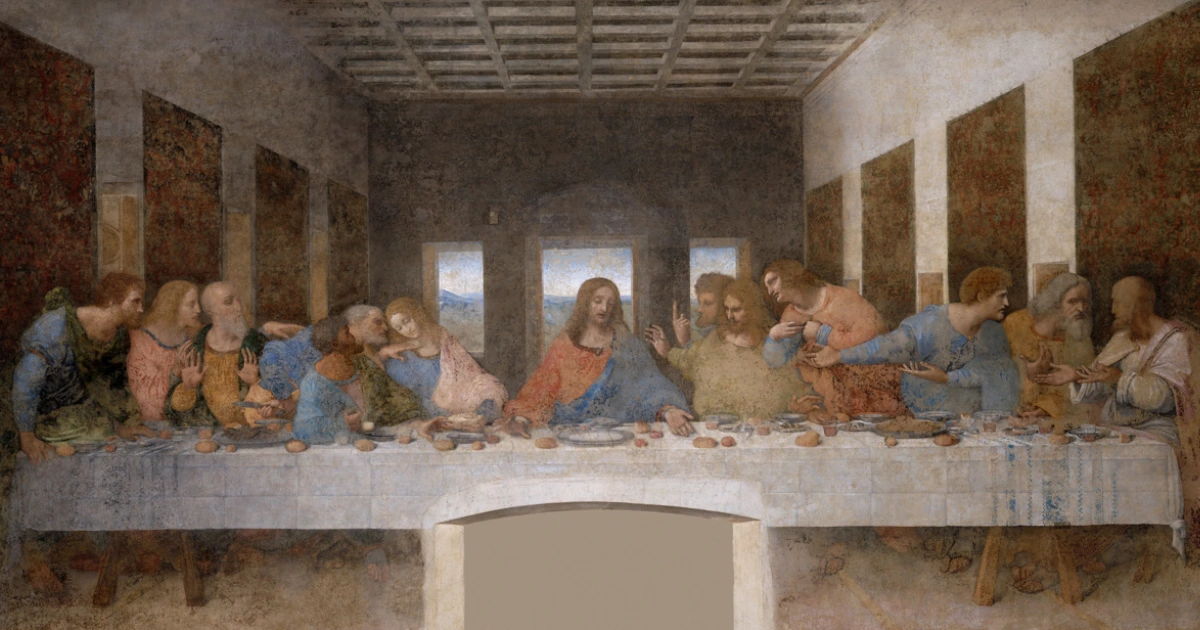
Leonardo’s compositions are never accidental. In The Last Supper, he arranged the twelve apostles into four groups of three, with Christ at the center — creating perfect symmetry while also capturing the psychological explosion of the moment when Jesus announces his betrayal.
He was also a master of expression. He spent years studying human anatomy specifically to understand how muscles create facial expressions. His figures don’t just stand there — they feel something, and viewers feel it too.
Exploring Leonardo’s painting style in depth reveals a lifetime of experimentation. Our detailed article on da Vinci’s painting style and sfumato technique explores these methods further, with comparisons across his major works.
Leonardo da Vinci’s Most Famous Paintings

Fewer than twenty paintings are reliably attributed to Leonardo. Each one is a landmark. Together, they form one of the most important bodies of work in the history of art.
The Mona Lisa
The Mona Lisa is, quite simply, the most famous painting in the world. It hangs in the Louvre in Paris behind bulletproof glass, drawing millions of visitors every year.
Painted between approximately 1503 and 1519, it depicts a woman — almost certainly Lisa Gherardini, wife of a Florentese merchant — against a hazy, dreamlike landscape. The genius of the painting lies in its ambiguity: the famous smile that seems to shift depending on where you look, and the eyes that appear to follow you around the room.
Our dedicated article on the Mona Lisa explores its history, the mystery of its subject, and why it became an icon.
The Last Supper
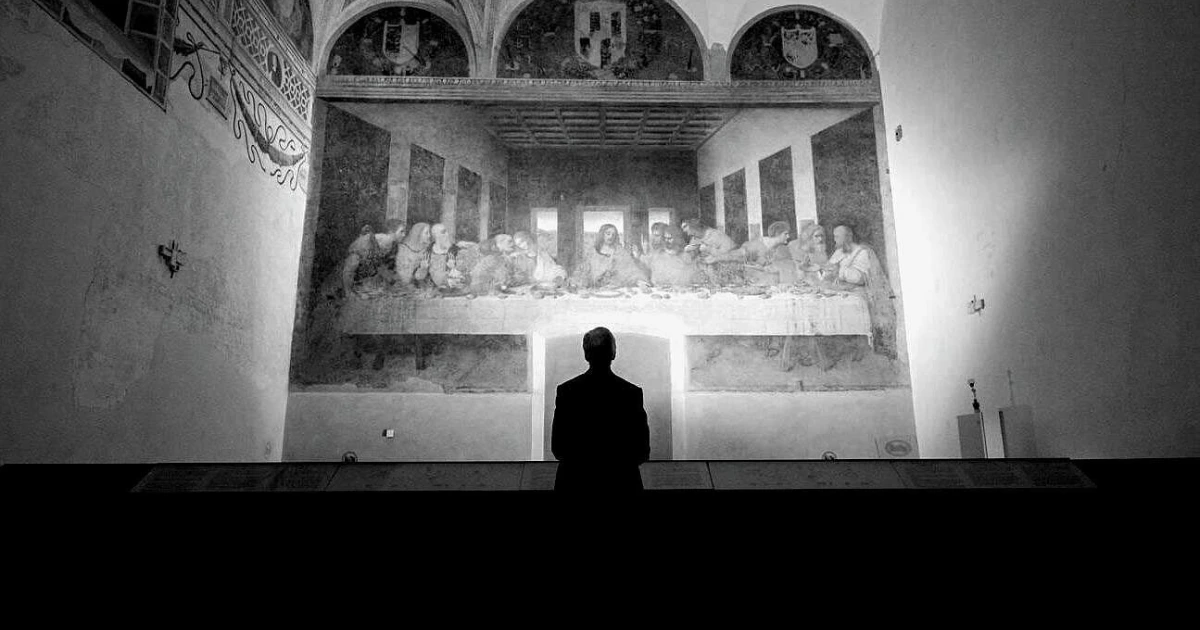
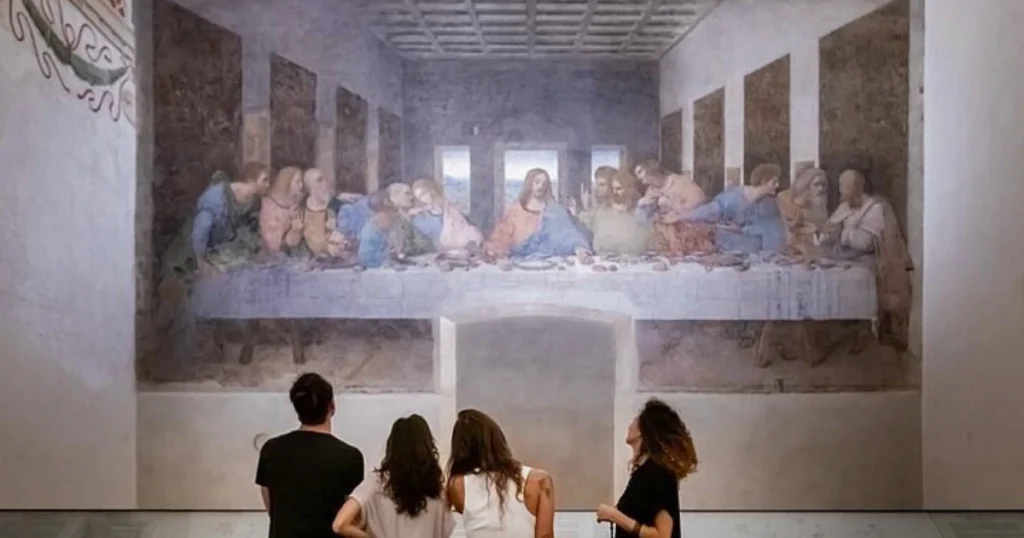
The Last Supper is not a panel painting but a large mural covering the end wall of a dining hall in Milan. Leonardo painted it between 1495 and 1498 using an experimental technique — applying tempera and oil to a dry plaster wall rather than the traditional fresco method of painting on wet plaster.
That experiment was also a problem. The paint began to deteriorate within decades. What we see today is the result of centuries of damage, retouching, and restoration. Yet even in its imperfect state, it remains one of the most powerful images ever created.
Our article on The Last Supper covers its full history, including the recent restoration work and how to visit it today.
Other Essential Works
Beyond these two icons, Leonardo’s catalogue includes works of equal sophistication. Lady with an Ermine, painted around 1489, is a portrait of extraordinary intimacy — the subject gazes sideways as if interrupted mid-thought, and the ermine she holds seems almost alive.
The Virgin of the Rocks exists in two versions — one in the Louvre and one in the National Gallery in London — and demonstrates Leonardo’s mastery of geological landscape and divine light.
Salvator Mundi, sold at auction in 2017 for $450 million, depicts Christ as Savior of the World and remains one of the most debated attributions in art history.
Other significant works include Ginevra de’ Benci (National Gallery of Art, Washington D.C.), Saint John the Baptist (Louvre, Paris), The Adoration of the Magi (Uffizi, Florence), Madonna Litta, and the haunting, unfinished Saint Jerome in the Wilderness.
Each of these works has its own dedicated article exploring its history, attribution, and significance. Together, they form a complete picture of Leonardo da Vinci paintings in order of his artistic development.
Where to Experience Leonardo da Vinci Artworks

One of the great pleasures of Leonardo’s legacy is that his works are spread across some of the world’s most compelling cities. Visiting them is not just an art pilgrimage — it is a journey through the heart of the Renaissance.
Florence: The Birthplace of Leonardo’s Art
Florence is where Leonardo began. The Uffizi Gallery holds some of his earliest surviving works, including The Annunciation, Ginevra de’ Benci (on loan from Washington), and the unfinished Adoration of the Magi — one of the most revealing works in his entire catalogue because it shows his underdrawing and compositional process in full.
Beyond the Uffizi, Florence itself is a living Leonardo museum. The streets, churches, and palaces he knew as a young man are largely intact. The town of Vinci, about an hour from Florence, houses the Museo Nazionale del Bargello’s collection of Leonardo-related material and the house where he was born.
Milan: Home of The Last Supper
Milan is essential for any serious Leonardo traveler. The Last Supper can be seen at Santa Maria delle Grazie — though visits must be booked months in advance, as only small groups are admitted at a time to protect the fragile mural.
The Pinacoteca Ambrosiana holds Portrait of a Musician, and the Castello Sforzesco contains drawings and artifacts from Leonardo’s years at the Sforza court. The Museo Nazionale della Scienza e della Tecnologia in Milan also holds reconstructed models of his engineering inventions.
Paris, London, and Washington D.C.
The Louvre in Paris holds the largest single collection of Leonardo paintings: the Mona Lisa, The Virgin of the Rocks, Saint John the Baptist, La Belle Ferronnière, and Saint Anne. A single morning in the Leonardo rooms of the Louvre is an extraordinary Leonardo exhibition in its own right.
The National Gallery in London holds the second version of The Virgin of the Rocks, as well as the recently restored Virgin of the Rocks, among the finest examples of his work in any public collection.
Ginevra de’ Benci is the only Leonardo painting on permanent display in the Americas, at the National Gallery of Art in Washington D.C.
How to Experience Leonardo’s World in Person
\Seeing a Leonardo da Vinci painting in a photograph is one thing. Standing in front of one is entirely another. The scale, the texture, and above all, the light — the way he made darkness and brightness coexist — cannot be replicated on a screen.
Planning a Leonardo Museum Visit
If you are planning a trip focused on Renaissance sites and Leonardo museums, some practical advice: book tickets for The Last Supper in Milan as far in advance as possible — popular slots sell out months in advance. The Louvre is best visited on a weekday morning to avoid crowds around the Mona Lisa, though even then, the room can still be busy.
Florence’s Uffizi Gallery requires advance booking during peak season (April through October). The city of Vinci itself is often overlooked, but a half-day visit to see the Museo Leonardiano and Leonardo’s birthplace in Anchiano is one of the most rewarding experiences for anyone deeply interested in his life.
Guided Tours and Cultural Experiences
Guided tours of Leonardo’s world — whether in Florence, Milan, or Paris — offer context that self-guided visits often miss. Expert guides can explain the technical details of sfumato, the political circumstances behind individual commissions, and the stories of the people Leonardo portrayed.
Many tour operators now offer specialist Renaissance art tours focused specifically on Leonardo, combining visits to multiple museums and historical sites across northern Italy. These itineraries often include access to lesser-known Leonardo drawings and manuscripts held in private or institutional collections.
Beyond the Paintings: Notebooks and Drawings
Leonardo’s paintings are only part of his legacy. His notebooks — thousands of pages of drawings, observations, and inventions, including the iconic Vitruvian Man — are held in collections across Europe, including the Biblioteca Ambrosiana in Milan, the Royal Collection at Windsor Castle, and the Institut de France in Paris.
Exhibitions drawing on these notebooks appear regularly in major cities. They offer a remarkable window into his thought process, showing how his scientific investigations and artistic work constantly informed one another. Checking museum websites for upcoming Leonardo exhibitions before you travel is well worth the effort.
Final Thoughts
This post is all about Leonardo da Vinci artworks — the paintings, the techniques, the history, and the enduring fascination they inspire. There is no other body of work quite like it in the history of art.
Leonardo painted very few pictures in his lifetime, yet each one seems inexhaustible. Scholars have spent centuries studying the Mona Lisa and The Last Supper, and new discoveries — new interpretations of the sfumato technique, new analyses of his underdrawings using infrared reflectography — continue to emerge.
What makes Leonardo da Vinci so endlessly fascinating is the scale of his ambition. He was not content to be a great painter. He wanted to understand everything — the movement of water, the structure of the human body, the mechanics of flight, the nature of light itself.
His paintings are where that ambition took its most concentrated and beautiful form. Visiting them, in the great museums and Renaissance cities where they have found their permanent homes, is one of the most rewarding experiences that cultural travel can offer.
FAQs about Leonardo da Vinci Artworks
Leonardo da Vinci’s most famous piece is the Mona Lisa, widely regarded as the most famous painting in the world. Its mysterious expression, innovative techniques, and global recognition have made it an enduring cultural icon displayed at the Louvre in Paris.
Leonardo created a small but influential body of work, including paintings, drawings, and studies. His most notable artworks include the Mona Lisa, The Last Supper, the Vitruvian Man, the Lady with an Ermine, and the Virgin of the Rocks, as well as many scientific sketches in his notebooks.
The painting Salvator Mundi, attributed to Leonardo da Vinci, was sold in 2017 for about $450 million to a buyer linked to Saudi Arabia, widely reported as acting on behalf of the Saudi crown prince. It remains the most expensive painting ever sold at auction.
The three most famous paintings by Leonardo da Vinci are generally considered to be the Mona Lisa, The Last Supper, and The Virgin of the Rocks. These works represent his mastery of composition, technique, and psychological depth during the Renaissance.
There is no definitive proof of Leonardo da Vinci’s sexuality, but historical records show he was accused of sodomy in 1476, though the case was dismissed. Because he never married and left little personal evidence, historians continue to debate his private life.
Leonardo da Vinci’s most valuable painting is Salvator Mundi, which sold for approximately $450 million in 2017, setting the world record for the highest price ever paid for a painting at auction.
Leonardo Bianchi is the founder of Leonardo da Vinci Inventions & Experiences, a travel and research guide exploring where to experience Leonardo’s art, engineering, and legacy across Italy and Paris.