
(Last updated: April 2026)
Leonardo da Vinci museums are among the most visited and most celebrated cultural destinations in the world — places where the full scope of one of history’s greatest minds comes into focus, not just through paintings, but through drawings, manuscripts, reconstructed machines, and the living memory of the cities that shaped him.
Leonardo was born in Tuscany in 1452 and spent his life moving between Florence, Milan, Venice, Rome, and finally France. Every city left its mark on him. Every city still carries his mark in return. The museums and institutions that now preserve his legacy are not simply art galleries. They are archives of a restless, insatiable curiosity that touched almost every field of human knowledge.
For travelers interested in Renaissance history, art, and science, following Leonardo across Italy and Europe is one of the richest cultural tourism journeys. Understanding which museums hold what, and why each collection matters, transforms a tourist visit into a genuine encounter with the Renaissance mind.
This guide explores the world of Leonardo da Vinci museums — where they are, what they hold, and how to make the most of a visit to each one.
What Are Leonardo da Vinci Museums?
Leonardo da Vinci museums preserve his paintings, drawings, notebooks, and inventions. From major galleries like the Louvre and Uffizi to sites like the Museo Leonardiano, they showcase his genius across art, science, and engineering in multiple countries.
Leonardo da Vinci museums list
Here is a clear overview of the most important Leonardo da Vinci museums across Europe, including what you can see at each location.
Planning Your Leonardo Museum Itinerary
Planning to visit? Use this quick guide to avoid crowds and choose the right Leonardo experience. (Some sites, especially The Last Supper, require advance booking — planning ahead makes all the difference.)
| Museum / Site | Location | What to See | Best For | Booking Needed | Best Time |
|---|---|---|---|---|---|
| Louvre Museum | Paris, France | Mona Lisa, a major Leonardo painting | First-time visitors, iconic art | Recommended | Early morning (opening hours) |
| Uffizi Gallery | Florence, Italy | Annunciation, Adoration of the Magi | Art lovers, Renaissance beginners | Recommended | Early morning or late afternoon |
| Museo Leonardiano | Vinci, Italy | Invention models, Leonardo’s birthplace | Families, invention enthusiasts | Not required | Mid-morning, weekdays |
| Santa Maria delle Grazie (Last Supper) | Milan, Italy | The Last Supper mural | Serious art travelers | Required (book weeks ahead) | Early morning slots |
| Museo Nazionale della Scienza e della Tecnologia | Milan, Italy | Machine models, engineering exhibits | Students, tech enthusiasts | Not required | Weekday mornings |
| Biblioteca Ambrosiana / Pinacoteca Ambrosiana | Milan, Italy | Codex Atlanticus, Portrait of a Musician | Scholars, history enthusiasts | Not required | Quiet weekday afternoons |
| Gallerie dell’Accademia | Venice, Italy | Vitruvian Man (rare display) | Advanced art lovers | Recommended | Early morning |
| Vatican Museums | Rome, Italy | Drawings, Renaissance collections | Cultural travelers | Recommended | Early morning or late entry |
| Castel Sant’Angelo Museum | Rome, Italy | Renaissance artifacts, historical context | History lovers | Not required | Late afternoon |
| Leonardo Interactive Museums | Florence, Rome, Milan | Hands-on models, inventions | Families, casual visitors | Not required | Midday (less crowded) |
| Château du Clos Lucé | Amboise, France | Leonardo’s home, invention models | Cultural travelers | Not required | Morning or early afternoon |
| Royal Collection Trust | Windsor, England | Anatomical drawings, manuscripts | Scholars, specialists | Limited access | Check exhibition schedules |
Each of these museums offers a different perspective on Leonardo’s genius — from original masterpieces to interactive engineering experiences.
Why Leonardo da Vinci Museums Matter
Leonardo da Vinci left behind fewer than twenty completed paintings. But he also left behind thousands of pages of notebooks — drawings of machines, studies of anatomy, observations about water, light, geology, and flight. No single museum holds everything. Understanding his legacy means understanding how it is scattered, and why.
His notebooks were never intended for publication. After his death in 1519, they passed through many hands before eventually being dispersed across collections in Milan, Windsor, Paris, Turin, and beyond. His paintings followed a similarly complex path. Some went to the French royal collection. Others remained in Italy. A few crossed the Atlantic.
The Renaissance Context Behind the Collections
To understand why Leonardo’s works ended up where they did, you need to understand the political world of the Renaissance. Leonardo worked under powerful patrons: Lorenzo de’ Medici in Florence, Ludovico Sforza in Milan, Cesare Borgia, the papacy in Rome, and finally King Francis I of France.
Each patron commissioned works and, in some cases, claimed or received them. When Ludovico Sforza fell from power in 1499, Leonardo left Milan, taking his notebooks but leaving behind The Last Supper, painted directly on the wall of a monastery dining hall, and unable to be moved.
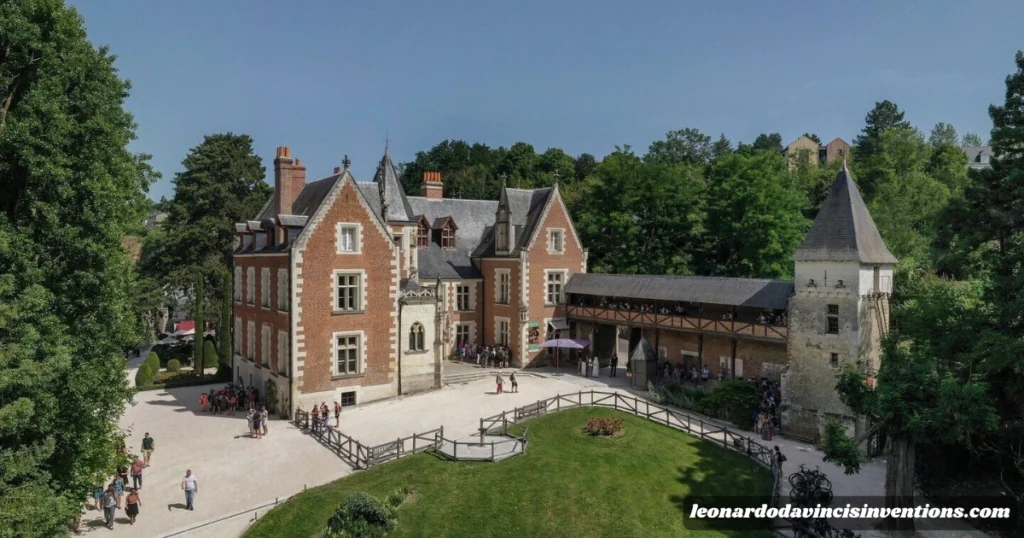
Francis I of France invited Leonardo to spend his final years at the Château du Clos Luce in Amboise. Leonardo brought several of his most important paintings with him — including the Mona Lisa — which is why the Louvre in Paris now holds the largest single collection of his paintings in the world.
Original Works Versus Experience Museums
There are two broad types of the Leonardo museum.
| Museum Type | Focus | What You See | Examples |
|---|---|---|---|
| Original Works Museums | Preserve authentic works created or touched by Leonardo | Paintings, drawings, manuscripts | Louvre (Paris), Uffizi (Florence), Biblioteca Ambrosiana (Milan), Bargello (Florence) |
| Interactive Experience Museums | Showcase Leonardo’s ideas through modern interpretation | Models, reconstructions, interactive exhibits, technology | Leonardo da Vinci Museum of Science and Technology (Milan), museums in Rome and Florence |
Both types are valuable. Original works give you direct contact with Leonardo’s hand. Experiencing museums deepens your understanding of his thinking and inventions.
How Institutions Preserve His Legacy
Preserving Leonardo’s works is an enormous ongoing task. The Last Supper in Milan underwent a major restoration lasting over twenty years, completed in 1999. Infrared reflectography and other modern imaging techniques have revealed underdrawings in his paintings that are invisible to the naked eye.
His notebooks are now largely digitized and accessible online through institutions like the Royal Collection Trust at Windsor and the Biblioteca Ambrosiana. But visiting the physical collections still offers something digital access cannot: the scale, the texture, and the presence of objects that Leonardo held in his hands.
Leonardo da Vinci Museum Florence: Where His Journey Began
Florence is the starting point for any Leonardo museum itinerary. It is where he trained, where he produced his earliest works, and where the great Uffizi Gallery now holds some of his most important early paintings.
The Uffizi Gallery
The Uffizi is one of the world’s great art museums, and for Leonardo travelers, it holds three works of extraordinary significance. The Annunciation, painted around 1472, is one of his earliest surviving paintings and shows the influence of his training under Verrocchio.
The unfinished Adoration of the Magi, begun in 1481, reveals Leonardo’s compositional process more clearly than almost any other work — the underdrawing is visible through the thin layers of paint, showing how he worked out complex arrangements of figures before committing to color.
The third Uffizi work is a red chalk self-portrait drawing attributed to Leonardo. Whether or not it is truly a self-portrait remains debated, but it is one of the most recognizable images of the Renaissance artist.
The Museo Leonardiano in Vinci
About an hour’s drive west of Florence, the small hilltop town of Vinci is Leonardo’s birthplace. The Museo Leonardiano spans two buildings in the historic center and houses a remarkable collection of models based on his notebook drawings — flying machines, hydraulic devices, weapons, and engineering tools.
Nearby, in the hamlet of Anchiano, Leonardo’s childhood home has been preserved and is open to visitors. It is a simple stone farmhouse with restored interiors and a short exhibition about his early life. The combination of the museum and the birthplace makes Vinci an essential stop on any Leonardo itinerary.
Interactive Leonardo Experiences in Florence
Several private museums and exhibition spaces in Florence offer the Leonardo da Vinci experience in an accessible, hands-on format. These are particularly popular with families and students. They present reconstructed models of his machines alongside reproductions of his drawings and notebooks, allowing visitors to understand the engineering logic behind his inventions.
These are not collections of original works, but they serve a genuine educational purpose — and they are often less crowded than the Uffizi, making them a good complement to a morning in the major galleries.
Leonardo da Vinci Museum Milan: The Heart of His Mature Work
Milan is where Leonardo spent the most productive years of his career. He arrived around 1482 and stayed until 1499, nearly two decades during which he produced The Last Supper, Lady with an Ermine, Portrait of a Musician, and thousands of pages of notebook drawings. No city outside Paris holds more of his work.
Santa Maria delle Grazie and The Last Supper
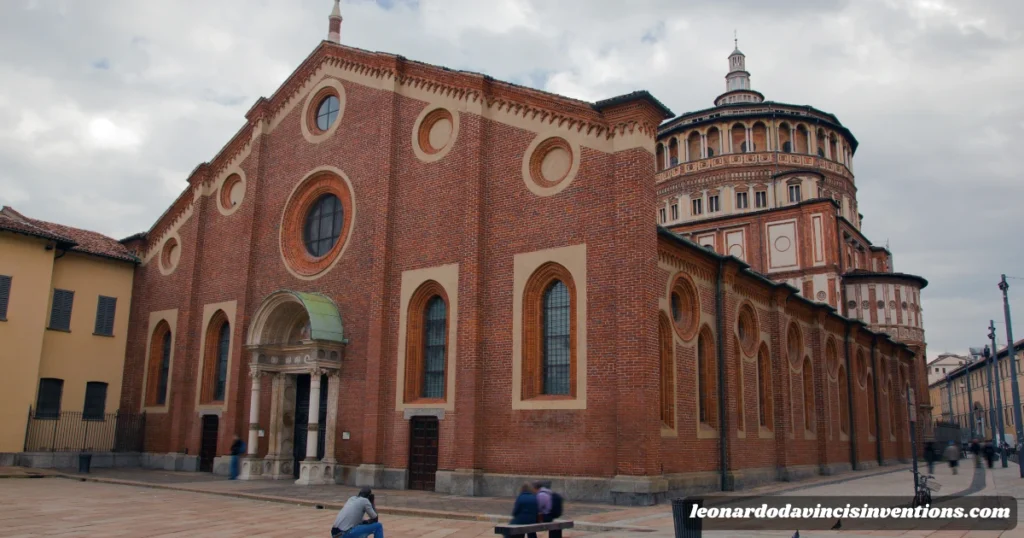
The refectory of Santa Maria delle Grazie is the single most important Leonardo site in Milan. The Last Supper covers the entire north wall of the room and remains one of the most emotionally powerful images in Western art, even after centuries of damage and restoration.
Visits must be booked in advance — often months ahead during peak season. Only groups of about 30 visitors are admitted at a time, for a 15-minute timed slot. The experience is brief but unforgettable.
The scale of the painting, which you cannot appreciate in photographs, is striking. And the restored colors — uncovered during the 1978-1999 restoration — are far more subtle and beautiful than the dark, deteriorated image most people know from reproductions.
Our dedicated article on Leonardo’s Last Supper museum experience covers the full history of the work, the restoration process, and detailed practical guidance for booking a visit.
The Museo Nazionale della Scienza e della Tecnologia
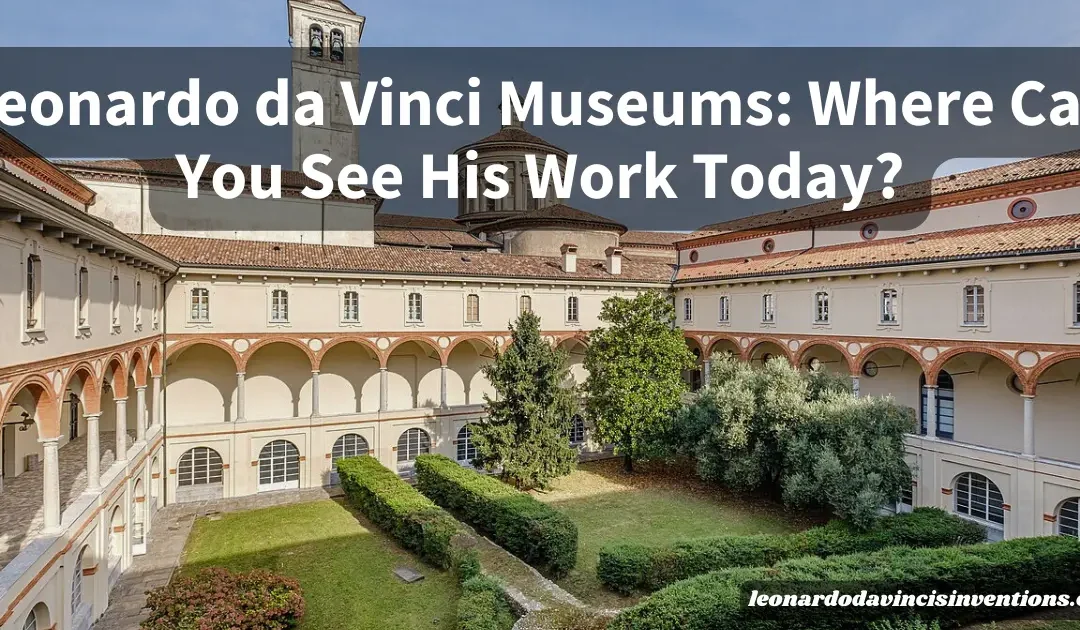
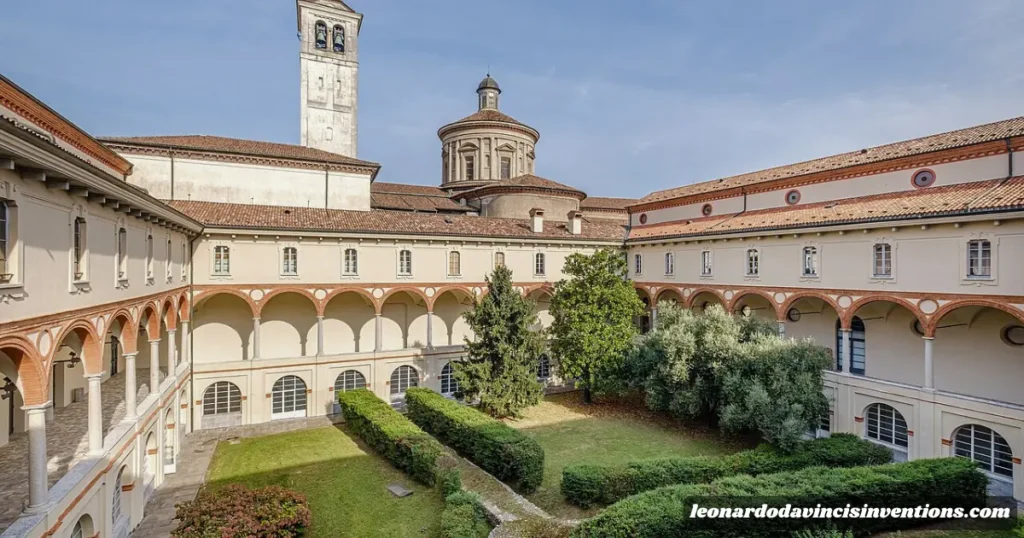
The Leonardo da Vinci Museum of Science and Technology (Museo Nazionale della Scienza e della Tecnologia) in Milan is Italy’s largest science and technology museum, and its Leonardo wing is a highlight for many visitors. It holds an extensive collection of wooden models built from his notebook drawings, grouped by theme: flying machines, hydraulics, civil engineering, military weapons, and more.
The museum also holds original pages from the Codex Atlanticus — Leonardo’s largest surviving collection of drawings and notes, now held in the Biblioteca Ambrosiana — on periodic display. The science and technology museum provides context that pure art galleries cannot: it explains not just what Leonardo drew, but why, and how his ideas relate to the history of technology.
The Pinacoteca Ambrosiana and the Codex Atlanticus
The Biblioteca Ambrosiana in Milan holds the Codex Atlanticus, a twelve-volume collection of Leonardo’s drawings and notes assembled in the late sixteenth century. It is the largest surviving collection of his manuscript material — over a thousand folios covering topics from mathematics to botany to military engineering.
The adjacent Pinacoteca Ambrosiana gallery holds Portrait of a Musician, one of the few male portraits Leonardo painted and one of his finest surviving works from the Milan period. Together, the Ambrosiana complex offers both the intimate scale of a single great portrait and the vast scope of the notebooks.
Da Vinci Museum Italy and Beyond
Leonardo’s legacy extends well beyond Florence and Milan. His paintings are scattered across Europe, and dedicated exhibitions and institutions in Rome, Venice, Paris, and elsewhere continue to expand the cultural geography of his world.
The Louvre, Paris
The Louvre holds more Leonardo paintings than any other institution in the world: the Mona Lisa, The Virgin of the Rocks, Saint John the Baptist, La Belle Ferronniere, and Saint Anne. For any serious Leonardo traveler, a morning in the Louvre’s Denon Wing is an essential experience.
The Mona Lisa hangs in the Salle des Etats, behind bulletproof glass, drawing enormous crowds. To see it well, arrive when the museum opens and go directly to the room before the crowds build. The other Leonardo paintings in the same wing are often less crowded and equally rewarding — Saint John the Baptist in particular is one of his most mysterious and accomplished works.
Paris also offers a related pilgrimage for those who want to understand Leonardo’s final years: Amboise, in the Loire Valley, where the Chateau du Clos Luce preserves his last residence and the gardens where he walked during his years in the service of Francis I.
Leonardo da Vinci in Rome
Leonardo spent two years in Rome between 1513 and 1516, working under the patronage of Giuliano de’ Medici and living in the Belvedere of the Vatican. No major painting survives from this period, but the Vatican Museums hold drawings and documentation related to his stay.
The Museo Nazionale di Castel Sant’Angelo holds material related to his contemporaries and the artistic culture of Rome during his lifetime. And several private Leonardo experience museums in Rome offer the interactive da Vinci museum format, with reconstructed machines and educational exhibitions.
Leonardo da Vinci Museum Venice, and the Vitruvian Man
Venice holds one of Leonardo’s most iconic drawings: the Vitruvian Man, dating from around 1490. The drawing — a figure inscribed in both a circle and a square, illustrating the proportions of the ideal human body as described by the ancient Roman architect Vitruvius — is held in the Gallerie dell’Accademia in Venice.
The Vitruvian Man is rarely on public display because of its fragility. It is shown only occasionally, for short periods, under carefully controlled conditions. When it does appear, the queue to see it is long. Our article on the Vitruvian Man and the Gallerie dell’Accademia covers when and how to see it, and explains the significance of the drawing in Leonardo’s scientific thinking.
Leonardo da Vinci Experience: Practical Travel Guide
Planning a Leonardo-focused trip requires some thought. His works are spread across multiple cities in multiple countries, and the most important sites — particularly The Last Supper in Milan — require advance booking. But the rewards are extraordinary.
Planning Your Leonardo Museum Itinerary
This quick guide shows where to go, what to see, and when to visit each site—helping you plan your trip efficiently and avoid common travel mistakes.
Some of the most popular Leonardo sites require advance booking or timed entry. Exploring each destination in detail will help you choose the right experience and make the most of your visit.
Guided Tours and Specialist Experiences
Guided tours add significant value to Leonardo museum visits, particularly at sites like The Last Supper and the Uffizi. Expert guides can explain the historical context, the technical details of Leonardo’s methods, and the stories of the people and events depicted in the paintings.
Many operators now offer specialist Renaissance art tours that combine multiple Leonardo sites across a single itinerary. These often include access to lesser-visited collections — notebook exhibitions, drawings in private or institutional collections, and architectural sites associated with his patrons.
The Leonardo da Vinci experience museum format — with its interactive models and digital presentations — is ideal for visitors with children or for those new to Renaissance history who want context before tackling the major art galleries.
Best Museums in Milan for Renaissance Art
Milan offers more than Leonardo. A dedicated Renaissance art visit to the city might combine the Last Supper and the Ambrosiana with the Pinacoteca di Brera — which holds major works by Raphael, Caravaggio, and Bramante — and the Castello Sforzesco, whose museums include Leonardo-era artifacts and drawings.
The Castello Sforzesco was the seat of Ludovico Sforza’s court, where Leonardo worked for nearly two decades. Walking through its rooms gives a vivid sense of the political and artistic world in which he operated.
Final Thoughts
This post is all about the Leonardo da Vinci museums across Italy, France, and beyond — tracing the path of a genius whose curiosity took him from a farmhouse in Tuscany to the court of the French king, and whose legacy now fills the greatest institutions of the Western world.
What makes Leonardo so endlessly compelling is the breadth of his interests and the depth of his insight. He was not simply a great painter. He was a scientist, an engineer, a philosopher, and an observer of everything.
The museums that preserve his work — from the Louvre to the Museo Leonardiano in Vinci — do not just hold objects. They hold evidence of one of the most extraordinary minds in human history.
FAQs about The Leonardo da Vinci Museums
Rome has three main museums/exhibitions dedicated to Leonardo da Vinci, all located in the city center. These include the exhibition at Palazzo della Cancelleria, the Leonardo da Vinci Experience near the Vatican, and the museum in Piazza del Popolo.
The “best” Leonardo museum depends on your interests, but many visitors favor the Palazzo della Cancelleria exhibition (Mostra di Leonardo) because it features many interactive models, holograms, and educational displays. It offers one of the most comprehensive and immersive experiences of Leonardo’s inventions.
Yes, there are multiple museums dedicated to Leonardo da Vinci across Italy, including Rome, Florence, Milan, and his birthplace, Vinci. These museums typically focus on models of his inventions, scientific studies, and reproductions of his works rather than original paintings.
Leonardo da Vinci museums are located in several key cities, including Rome (multiple interactive museums), Florence/Vinci (his birthplace, home to the Museo Leonardiano), and Milan (home to the National Museum of Science and Technology dedicated to him). Each location highlights different aspects of his life and work, including inventions, art, and engineering.
The Museo Nazionale della Scienza e della Tecnologia Leonardo da Vinci in Milan is considered the largest Leonardo-focused museum, with thousands of objects and extensive exhibits dedicated to his scientific and technological contributions.
Some of the must-see museums in Rome include the Vatican Museums (home to world-famous art collections), the Borghese Gallery (Renaissance and Baroque masterpieces), the Capitoline Museums (ancient Roman art and history), and the Leonardo da Vinci museums (interactive experiences of his inventions). These institutions together offer a comprehensive view of Rome’s artistic and historical heritage.
 Leonardo Bianchi is the founder of Leonardo da Vinci Inventions & Experiences, a travel and research guide exploring where to experience Leonardo’s art, engineering, and legacy across Italy and Paris.