
(Last updated: April 2026)
Leonardo perpetual motion machine has intrigued thinkers for centuries, challenging the very laws of physics.
The idea of a machine that moves forever without external energy is captivating but impossible, given principles such as the conservation of energy.
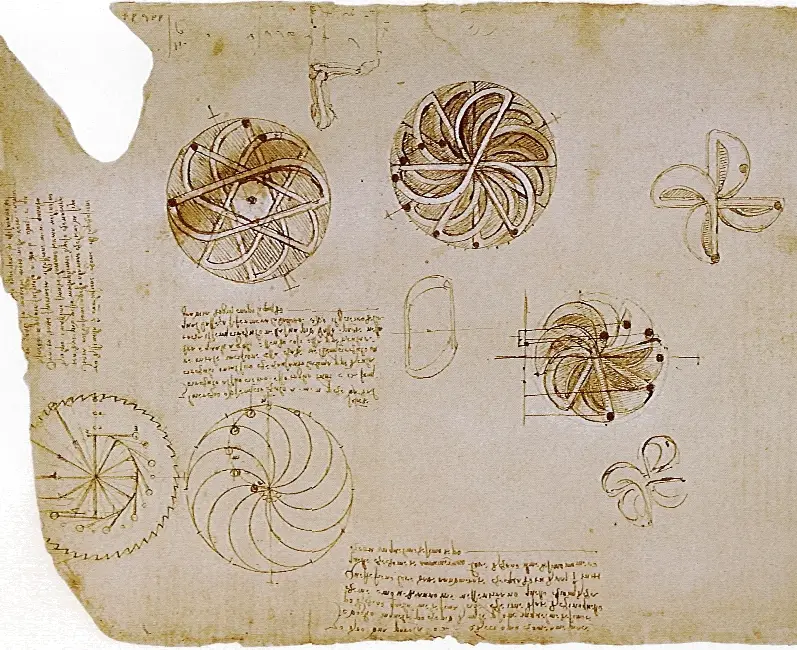
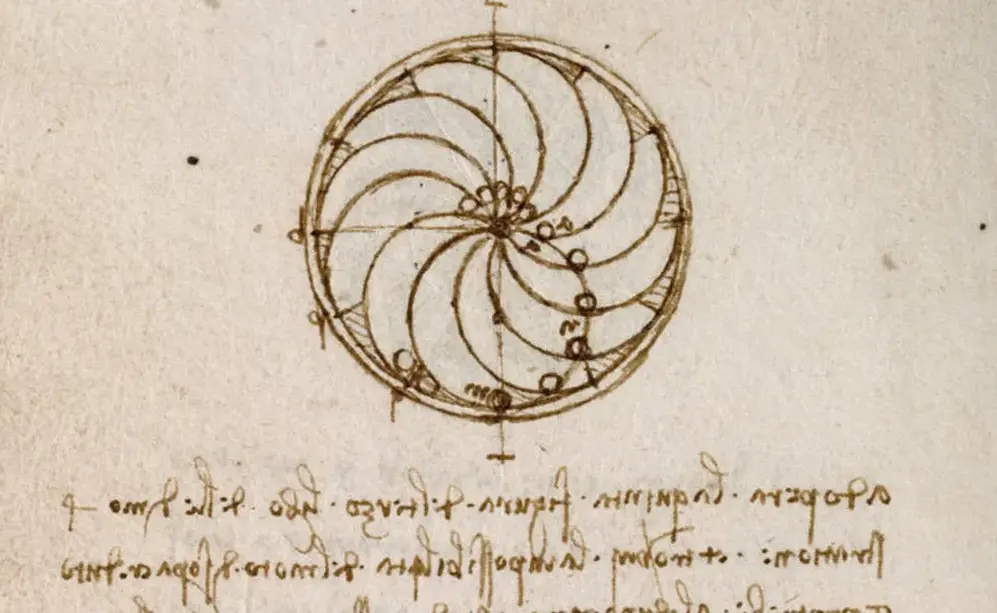
His first design sketches, simple yet ingenious, included a wheel with ball bearings shifting its center of gravity, theoretically allowing continuous motion.
Fascinated by mechanics, Leonardo da Vinci tackled the age-old problem of designing such machines. While his perpetual motion efforts eventually proved unfeasible, they offered valuable insights into mechanical motion.
His explorations are well documented in manuscripts such as the Codex Atlanticus, which showcase a range of ideas, from overbalanced wheels to centrifugal pumps.
Historians and engineers continue to study Leonardo’s work, not for its practicality but for the creativity it represents. Although Leonardo acknowledged the challenges, his experiments demonstrate his relentless curiosity and innovation.
Leonardo da Vinci’s Quest for Perpetual Motion
Leonardo da Vinci explored the concept of perpetual motion when inventors were eager to solve this intriguing challenge. He created detailed designs and drawings, demonstrating his innovative approach to mechanical motion.
Historical Context
During the Renaissance, inventors were fascinated by a machine that could operate indefinitely without an external energy source.
This quest involved creating a perpetual motion machine capable of endless movement. Da Vinci’s investigations into this concept occurred during an era of scientific curiosity and technological advancement.
Although the science of the time had not yet ruled out the possibility, later thermodynamic studies showed that perpetual motion could not be achieved.
Da Vinci’s Conceptual Designs
Leonardo’s designs were a testament to his creativity and engineering prowess. One well-known creation was the da Vinci wheel, which features overbalanced wheels with weights to keep the machine in continuous motion.
Another example included intricate systems of ball bearings across multiple tracks, designed to continuously shift the wheel’s center of gravity and sustain rotation.
While captivating, these designs remained theoretical and have not achieved perpetual motion. If you are interested in Da Vinci’s mechanical inventions, you can find more insight into his unique approach.
The Science of Perpetual Motion
Understanding why perpetual motion machines like Leonardo’s cannot function involves fundamental physics.
The laws of thermodynamics, developed centuries later, explain that energy cannot be created or destroyed, making perpetual motion impossible.
These principles rendered it infeasible for machines to operate without energy loss. Leonardo’s attempts highlight early human efforts to question and push the boundaries of the physical world, inspiring generations of inventors and enthusiasts.
Mechanical Principles Behind Perpetual Motion
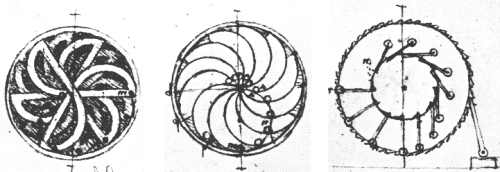
Leonardo’s first perpetual motion invention is a simple overbalanced wheel.
In the above design, the weight of the ball bearings within the machine constantly shifts the wheel’s center of gravity away from the center point, allowing continuous rotation.
The design has three tracks, each with its ball bearing running within it.
His second design incorporates levers, a pawl, and a racket system into the overbalanced wheel. The wheel’s central hub ensures the levers are controlled throughout its rotation.
The pawl-and-ratchet system prevents the wheel from rotating clockwise. This can be seen in the images above and will be demonstrated in the video at the bottom of the page.
His third and most elegant design is for another overbalanced wheel. This design has twelve tracks, each bearing a ball.
Once again, the center of gravity is constantly shifted by the movement of the balls along the curved tracks during the wheel’s rotation. This design is shown in the images above and demonstrated in operation in the video at the end of the page.
Leonardo decided against investigating perpetual motion any further after he wrote (in mirror writing) beside the designs: “For every action, there is an opposite and equal reaction” (the machines would not work).
That quote is also from Isaac Newton’s Third Law of Motion, which was written 200 years before Newton was born!!!
Understanding the Conservation of Energy
The conservation of energy principle states that energy cannot be created or destroyed; it can only be transformed from one form to another.
In a perpetual motion machine, energy must be continuously generated without input. However, a perpetual motion machine of the first kind violates this law because it claims to produce work without any energy source.
Leonardo da Vinci understood this challenge and recognized the difficulty in achieving continuous motion without an energy supply. While he designed various machines, such as the da Vinci wheel, his studies concluded that energy loss through friction and other forces made perpetual motion impossible.
Challenges in Creating a Perpetual Motion Machine
Creating a perpetual motion machine involves overcoming significant obstacles related to mechanical efficiency and energy loss.
The machines must achieve continuous work output without any energy input, which contradicts fundamental laws of physics.
Leonardo’s perpetual motion machine attempts demonstrated how friction and air resistance decrease efficiency, leading to energy loss.
Influence and Legacy
Leonardo da Vinci’s exploration of perpetual motion machines, although he concluded that such devices were impossible, left a lasting impression on science and art. His ideas continue to inspire inventors and creative minds worldwide.
Impact on Future Generations of Inventors
The Leonardo da Vinci perpetual motion machine influenced future generations of inventors by encouraging them to explore the boundaries of possibility.
Although he determined that perpetual motion couldn’t exist, his dedication to understanding mechanics provided valuable insights for future scientists and engineers.
His investigations demonstrated the importance of experimentation and the scientific method, laying the groundwork for later technological advancements.
Inventors were inspired to examine the laws of physics more deeply. They explored ways to minimize energy loss in machines, thereby improving efficiency across many fields.
This enduring curiosity highlights Leonardo’s role in pushing the limits of human imagination in pursuit of scientific truth.
Modern Interpretations and Artistic Inspirations
In contemporary times, the idea of the da Vinci wheel remains a powerful symbol of innovation.
Artists and creators draw inspiration from Leonardo’s inventions. His work’s intersection of art and science captivates creative minds, leading to unique interpretations across various media.
Art installations and creative projects often feature elements reminiscent of the perpetual motion machine example. These creations pay homage to Leonardo’s ingenuity and reflect the timeless allure of attempting the impossible.
Through exhibitions and artistic endeavors, the concept of perpetual motion fascinates and challenges perceptions of nature and technology.
Myths and Misconceptions
Leonardo da Vinci’s plans for a perpetual motion machine have inspired fascination for centuries.
Despite this intrigue, the fundamental question remains: Is there a perpetual motion machine? The concept continues to stir debates and misconceptions in scientific circles and beyond.
Dispelling Common Myths
Perpetual motion machines are often thought to defy the basic laws of physics. Many believe Da Vinci’s wheel, a well-known perpetual motion invention, could work indefinitely without external energy.
This is a myth. The laws of thermodynamics state that energy cannot be created or destroyed, making true perpetual motion impossible.
Leonardo’s designs, though innovative, were theoretical. None of the designs, including his self-spinning wheel, have succeeded because they require an energy source to overcome natural resistance and friction.
Despite this, the allure of breaking free from energy constraints fuels imagination.
The Physics of Impossibility
The theory of perpetual motion conflicts with established scientific principles.
For example, the first law of thermodynamics states that energy in a closed system remains constant. In practical terms, this means perpetual motion cannot exist. Even Leonardo da Vinci’s perpetual motion machine falls short due to these fundamental laws.
The second law of thermodynamics further clarifies the impossibility by highlighting the concept of entropy.
It dictates that energy systems tend to move towards disorder. Machines cannot operate continuously without energy loss. Hence, these principles invalidate attempts to create self-sustaining devices.
Examining Modern Iterations
Leonardo da Vinci’s concepts of perpetual motion have sparked interest in modern attempts to bring such machines to life. These efforts explore whether perpetual motion can genuinely exist.
Contemporary Experiments
Contemporary experiments often focus on the possibility of creating a successful perpetual motion machine.
Innovators try various designs inspired by historical figures like Leonardo da Vinci. Experiments include overbalanced wheels similar to those in Da Vinci’s designs, which use weights to maintain continuous motion.
Despite efforts, no working perpetual motion machine has been demonstrated due to the laws of thermodynamics, which state that energy cannot be created or destroyed. Thus, the question remains: Is perpetual motion possible?
Perpetual Motion in Popular Culture
Perpetual motion fascinates not only scientists but also popular culture. Movies, books, and TV shows often explore the concept, imagining worlds where these machines defy the laws of physics. The intrigue of designs like Leonardo da Vinci’s wheel captures the public imagination.
The idea remains a topic of debate, with skeptics questioning whether perpetual motion exists. While the answer, in reality, is no, these devices offer endless possibilities in fiction.
This continued fascination keeps the discussion alive, blending history, science, and fantasy in ways that captivate audiences worldwide.
Final Thoughts
Leonardo’s perpetual motion machine has fascinated people for centuries. Although he concluded that actual perpetual motion was impossible, his designs and experiments contributed significantly to the study of mechanics.
His exploration of self-propelling machines included concepts like the overbalanced wheel. In this design, ball bearings are shifted continuously to drive the motion.
The concept of perpetual motion challenged him to solve technical problems, such as friction between moving parts. He studied how machines might overcome these issues using creative designs.
Despite determining perpetual motion could not be achieved, Leonardo’s work in this area showed his innovative thinking and ability to push the boundaries of existing knowledge.
Key Takeaways: Leonardo’s efforts illustrate his genius and curiosity. While perpetual motion machines remain impossible, his ideas have inspired countless inventors and engineers. The mythical allure of machines that move forever without energy has led to further exploration of alternative energy sources and improvements in machine efficiency.
FAQs about Leonardo Perpetual Motion Machine
No, a true perpetual motion machine is considered impossible according to modern physics. It would violate the laws of thermodynamics, especially the conservation of energy and the principle that energy is always lost to friction or heat.
There is no fully verified historical record of Leonardo da Vinci’s exact last words. Some later accounts claim he expressed regret about not fully realizing his potential, but these reports lack direct evidence and remain uncertain.
There is no confirmed inventor of a working perpetual motion machine, but early designs date back to the Middle Ages, including concepts by figures like Villard de Honnecourt and Bhāskara II, who proposed wheels that were supposed to run indefinitely.
No, no one has ever successfully built a true perpetual motion machine. Despite many attempts throughout history, all designs either fail or rely on hidden energy sources, making them scientifically invalid.
There is no scientific evidence that time travel will be possible by 2050. While theoretical physics explores concepts like relativity and wormholes, practical time travel—especially to the past—remains speculative and far beyond current technology. (No credible scientific confirmation available.)
We are not close to creating a perpetual motion machine, because it violates fundamental physical laws. Even highly efficient modern machines still lose energy, meaning true perpetual motion remains unattainable in principle.
 Leonardo Bianchi is the founder of Leonardo da Vinci Inventions & Experiences, a travel and research guide exploring where to experience Leonardo’s art, engineering, and legacy across Italy and Paris.