
(Last updated: April 2026)
Da Vinci Landing Gear remains one of the lesser-known yet fascinating innovations of the Renaissance genius.
He crafted a landing gear system prototype to help early flying machines take off and land safely.
This invention demonstrates Leonardo da Vinci‘s forward-thinking approach to solving flight challenges when aviation was still a dream.
Exploring the intricacies of his landing gear concept reveals Leonardo’s impressive understanding of mechanical devices.
The design showcased elements intended to reduce shock during landing, highlighting his anticipation of real-world flying conditions.
Current flying machines owe a nod to Da Vinci’s pioneering ideas, which set a foundation for modern aviation technology.
Leonardo’s contributions go beyond painting and sculpture, showcasing his multifaceted genius.
His work on flight, including his landing gear designs, underscores his timeless influence and innovative spirit.
For those seeking to uncover the mind behind these inventions, learning about his landing gear can spark an interest in history and aviation.
Historical Context of Da Vinci’s Designs
Leonardo da Vinci’s contributions to engineering are profound, reflected in his work on the Da Vinci Landing Gear and other innovative designs. These works showcased his imagination and scientific approach during the Renaissance, making a lasting impact.
Early Sketches and Concepts
Leonardo da Vinci’s early sketches reveal a mind deeply engaged with the mechanisms of flight.
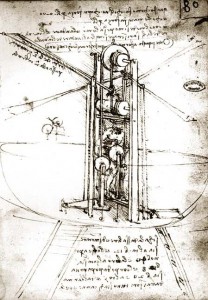
His designs often involved intricate systems of gears and pulleys, exemplified by the Leonardo Da Vinci Landing Gear.
This early concept represents one of the first attempts to tackle the challenge of landing stability in a flying machine.
Although he explored numerous ideas, such as ornithopters and spiral gears, these were mainly theoretical due to the technological limitations of his time.
Da Vinci’s work laid the groundwork for future inventors and remains a testament to his innovative spirit.
His drawings provide valuable insights into his efforts to make flight feasible long before the Wright brothers succeeded.
Influence on Renaissance Engineering
Da Vinci’s engineering pursuits significantly inspired his contemporaries and future generations.
His use of da Vinci gears and other complex mechanical systems showcased the era’s fascination with blending art with science.
During the Renaissance, a period marked by exploration and innovation, his designs, like the Leonardo da Vinci flying machine, stood out for their detail and ambition.
Though not all his concepts were constructed, they influenced the engineering principles that emerged in later centuries.
His approach bridged the gap between imagination and mechanical reality, demonstrating how art and technology could coexist.
Da Vinci’s legacy in engineering remains influential as a visionary, highlighting the importance of curiosity and creativity in scientific progress.
Overview of Da Vinci Landing Gear
The Da Vinci Landing Gear is an innovative design showcasing Leonardo da Vinci’s mechanical ingenuity. It features unique mechanical principles, specific design specifications, and applications for envisioned flying machines.
Mechanical Principles
Da Vinci’s Landing Gear utilized concepts such as levers and pulleys. These mechanical components provided control and stability during take-offs and landings.
The design incorporated da Vinci’s understanding of momentum and force, integrating gears to regulate the movement of the landing gear components.
This forward-thinking approach enabled compensation for mechanical stresses, which is crucial to maintaining the aircraft’s structural integrity.
Design Specifications
Leonardo da Vinci’s design featured wooden frames combined with leather, ropes, and spring combinations to absorb impact.
The light yet durable materials suited the limited technological capabilities of his time.
The landing gear system, reminiscent of a modern bicycle’s suspension, aimed to provide a smooth landing experience.
His attention to detail ensured the landing system’s effectiveness, especially when precise control was necessary for safe operation.
Intended Aircraft Applications
The Da Vinci Landing Gear was conceptualized for one of his flying machine designs, particularly a glider-like structure.
While Leonardo da Vinci did not build a flying machine, his designs, including the spiral-helical wing concept, hinted at practical ideas for flight.
The landing gear’s role was to ensure a safer and more controlled experience during experimental flights, paving the way for future aviation advancements.
Although his work was not realized in his lifetime, it laid the groundwork for the study of aircraft landing systems in later centuries.
Technical Analysis of Da Vinci Landing Gear
The Da Vinci Landing Gear showcases Leonardo’s ingenuity, combining material innovation with mechanical complexity. Its design reflects Da Vinci’s fascination with flight and the principles of physics that govern such mechanisms.
Material Considerations
Leonardo Da Vinci’s landing gear would have been primarily crafted from wood and metal, typical materials available during the Renaissance.
These materials were chosen for their strength and durability, which are crucial for the safe landing of his flying machines.
Metal components reinforced the structure, providing necessary support where wooden elements might falter under stress.
Rope or leather might also have been incorporated to aid in the retraction and extension of the gear, highlighting Leonardo’s attention to functionality and practicality.
Stress and Load Calculations
Da Vinci gears in the landing mechanism needed to withstand significant force during landing.
He likely calculated the stress on each component to ensure safety and stability.
Leonardo aimed to evenly distribute stress throughout the structure by understanding how weight and impact forces interact.
This foresight helped prevent potential failures, ensuring the stability of Leonardo da Vinci’s flying machine during touchdown.
It showed his remarkable grasp of mechanics and foreshadowed principles in modern engineering stress analysis.
Comparative Analysis with Modern Gear

The evolution of materials and techniques is evident when comparing Leonardo Da Vinci’s landing gear to modern landing gear.
Contemporary gear systems use advanced materials such as carbon composites and titanium to achieve higher strength-to-weight ratios.
While the technology of his era limited Da Vinci’s designs, they laid the groundwork for modern landing gear systems.
The contrast highlights how his early conceptual work influenced today’s innovations, bridging historical creativity with modern advancements in aerospace design.
FAQs about Da Vinci Landing Gear
No, none of Leonardo da Vinci’s full-scale flying machines successfully worked in his lifetime. His designs remained sketches and concepts because the materials and power sources available during the Renaissance were insufficient to achieve sustained flight.
Leonardo da Vinci did not invent gears, as they had existed since ancient times. However, he made important contributions by designing complex gear systems and mechanical devices, improving the use of gears in machines and automation.
The first successful powered airplane is widely credited to the Wright brothers, who achieved controlled, sustained flight in 1903. Earlier inventors like Leonardo da Vinci created theoretical designs, but they were not built or flown.
Leonardo’s aerial screw—often considered a prototype helicopter—did not work in practice. The design lacked a powerful engine and used materials that were too heavy, rendering it incapable of generating sufficient lift for human flight.
Leonardo da Vinci did not invent the airplane, but he was among the first to study flight scientifically and to design machines resembling airplanes and helicopters. His work laid early conceptual foundations for aviation centuries before it became a reality.
Leonardo da Vinci’s most famous invention is often considered his flying machine (ornithopter), which attempted to mimic the motion of bird wings. It represents his deep interest in flight and remains one of his most iconic engineering ideas.
 Leonardo Bianchi is the founder of Leonardo da Vinci Inventions & Experiences, a travel and research guide exploring where to experience Leonardo’s art, engineering, and legacy across Italy and Paris.