
(Last updated: April 2026)
Leonardo da Vinci car, a self-propelled cart, showcases the ingenuity of this Renaissance polymath.
He designed this cart to move independently without external force, making it a pioneering idea in transportation.
While the concept was conceived in the 15th century, the technology was advanced and foreshadowed future automotive developments.
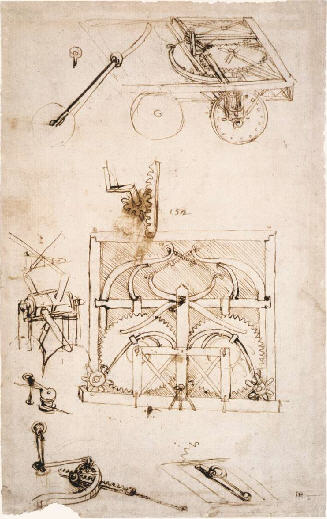
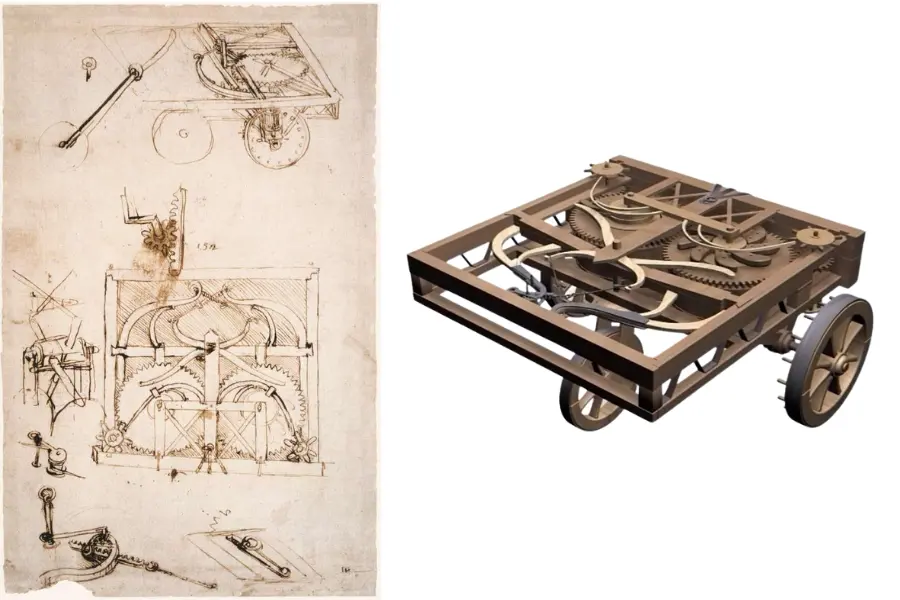
This self-propelled vehicle, known as Leonardo’s self-propelled cart, functions with a complex system of gears and springs that propel it forward.
Despite being invented long before engines, the cart is often regarded as the ancestor of modern cars, drawing interest from historians and engineers alike.
Its innovative design showcased da Vinci’s exceptional foresight into future technological advancements.
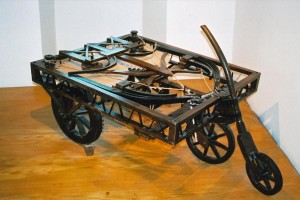
In the early 2000s, a team from The Institute and Museum of the History of Science in Florence attempted to bring Leonardo’s vision to life.
They meticulously recreated the car, using the original designs and materials specified by da Vinci.
This project highlighted the challenges and the brilliance of his original blueprint, inspiring modern inventors and historians to re-examine da Vinci’s contributions to the world of transport.
Leonardo da Vinci: The Inventor
FAQs about Leonardo da Vinci Car
Leonardo da Vinci did not invent the modern car, but he designed a self-propelled cart around 1478, which is widely considered a precursor to the automobile. His design used springs and gears to move without human pushing, making it one of the earliest concepts of a vehicle.
No, Leonardo da Vinci did not own or use a car in the modern sense. His self-propelled cart existed only as a design in his notebooks and was never built or used during his lifetime.
The earliest known sketch of a self-propelled vehicle, from 1478, is attributed to Leonardo da Vinci. His drawings in the Codex Atlanticus show a spring-powered cart that could move and even follow a programmed path.
Many experts expect self-driving cars to be widely developed and more common by 2050, as autonomous technology is already advancing rapidly. However, full global adoption will depend on safety, regulation, and infrastructure improvements, so timelines may vary by region. (General consensus based on current technological trends; no single definitive source.)
The first full-scale working automobile is usually credited to Nicolas-Joseph Cugnot, who built a steam-powered vehicle in 1769–1770. Later, Karl Benz developed the first modern gasoline-powered car in 1886.
Mercedes-Benz came first. Its origins trace back to Karl Benz’s automobile in 1886, while BMW was founded later in 1916. This makes Mercedes one of the oldest car manufacturers in the world.
 Leonardo Bianchi is the founder of Leonardo da Vinci Inventions & Experiences, a travel and research guide exploring where to experience Leonardo’s art, engineering, and legacy across Italy and Paris.