
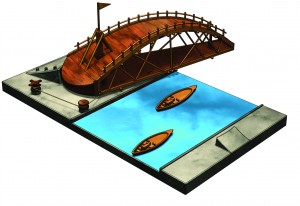
(Last updated: April 2026)
Leonardo da Vinci swing bridge showcases his brilliance in blending art and engineering.
This unique invention was designed to pivot, allowing bridges to be retracted to prevent enemy crossings while also enabling friendly passage.
By exploring da Vinci’s ingenuity, you can appreciate how his designs for a movable bridge addressed both functional and strategic needs at the time.
The da Vinci swing bridge represents a fascinating example of innovation for those intrigued by historical engineering marvels.
This bridge used a series of winches and wheels, showcasing the advanced thinking that da Vinci applied to solving practical problems. Da Vinci’s Revolving Bridge further illustrates his contributions to military strategy by enabling quick, effective transport across water obstacles.
Through this exploration, one gains insight into da Vinci’s versatility. His ability to design for civilian and military purposes highlights his invaluable contributions to civil engineering.
The swing bridge is just one example of how his mechanical ideas inspire innovation today.
Overview of the Leonardo da Vinci Swing Bridge
Leonardo da Vinci designed the swing bridge to combine practicality and innovation.
It served civilian and military purposes, providing quick and strategic access across waterways while keeping enemies at bay. Key aspects include its functional use and historical significance in engineering.
The Concept Behind the Swing Bridge
The Leonardo da Vinci swing bridge was crafted with versatility in mind.
Intended for tactical advantages, it allowed travelers and soldiers to cross rivers swiftly.
What made it distinct was its ability to swing open and retract to prevent enemy access. This design showcased da Vinci’s brilliance in engineering, blending simplicity with strategic depth.
The structure used wooden beams interlocked to provide strength and flexibility. This engineering feat reflected da Vinci’s understanding of physics and mechanics, enabling the bridge to support significant weight while remaining operationally efficient.
Such concepts demonstrated how innovative design approaches could solve practical problems of the time.
Historical Context of Leonardo da Vinci’s Designs
During Leonardo’s era, the need for movable bridges was essential, particularly in times of conflict.
The Leonardo da Vinci bridge was developed under the patronage of powerful leaders like Cesare Borgia, who sought effective solutions for military campaigns.
Da Vinci’s designs were not just architectural marvels but also tools of war.
His bridges, including the swing and revolving bridges, were pioneering in their time and laid the groundwork for modern movable bridges.
Through these designs, da Vinci provided insights into how to build a Leonardo da Vinci bridge using practical yet advanced techniques that have inspired engineers for generations.
How the Leonardo da Vinci Swing Bridge Works
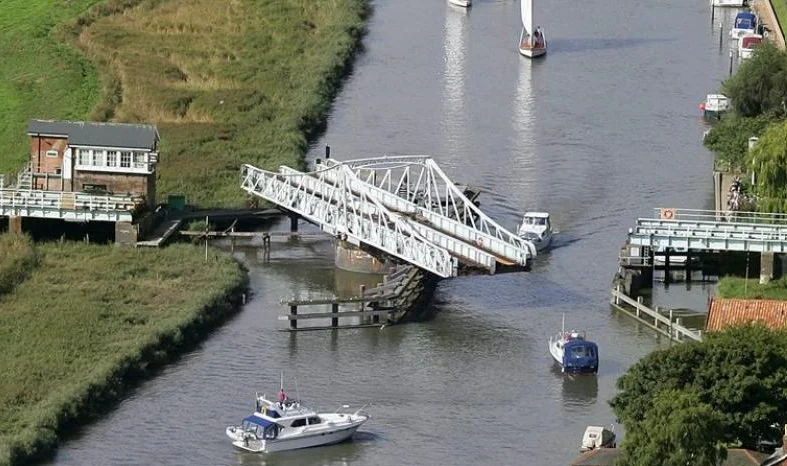
The Leonardo da Vinci swing bridge represents an ingenious feat of engineering. Its design allows for practical use and strategic defense, providing insights into da Vinci’s brilliance.
Mechanics of the Swing Bridge Design
The swing bridge is a masterpiece of engineering. Its central pivot allows it to turn 360 degrees.
This pivot is fixed on one bank, enabling the bridge to rotate quickly. Ropes and pulleys complement this mechanism, helping move the bridge smoothly.
Despite its size, a single person could maneuver the swinging bridge, illustrating da Vinci’s clever use of force distribution.
Crafted to be functional and defensive, the bridge was initially designed for military purposes.
It could span rivers or trenches and then be swung aside to prevent enemy crossings. This design’s simplicity and adaptability highlight da Vinci’s innovative approach to construction in the 15th century.
Advantages of the Swing Mechanism
The swing mechanism provided several advantages.
First, it offered rapid deployment and retraction, making it ideal for military operations. Soldiers could cross and secure strategic points quickly without needing a permanent bridge.
Additionally, the revolving nature of the da Vinci bridge allowed it to be moved to prevent enemy access.
This strategic advantage meant that it functioned not only as a passage but also as a deterrent.
The design also reflects da Vinci’s broader philosophy of harmonizing design with natural forces.
The way forces interlocked and provided stability showcases his understanding of engineering principles.
This combination of practicality and innovation makes the Leonardo da Vinci swing bridge a standout in the history of engineering.
Applications of the Leonardo da Vinci Swing Bridge
The Leonardo da Vinci Swing Bridge, a marvel of engineering, was not just a concept but a practical solution for various scenarios.
It combined innovation and functionality, allowing for military and civilian applications throughout history.
Historical Uses in Warfare
Leonardo da Vinci designed the swing bridge with military purposes in mind.
Mobility was crucial for armies during his time, especially when crossing rivers or canals. The revolving bridge enabled troops to cross bodies of water swiftly, facilitating strategic deployments and retreats.
The da Vinci Bridge could rotate 90 degrees, using a system of winches and wheels, to allow or block boats’ passage.
This function made it a defensive asset, providing a tactical advantage by controlling access to certain areas.
Modern Interpretations and Uses
Today, the Leonardo da Vinci Swing Bridge concept continues to inspire modern engineering projects.
Its design principles are used in educational settings to demonstrate the ingenious application of levers and balance. The self-supporting bridge exemplifies how ancient techniques can influence modern architecture and mechanical design.
Contemporary designers have adapted these principles to create structures requiring quick assembly or temporary setups.
This bridge’s ability to facilitate smooth water traffic control has been mirrored in several current canal and river management projects.
The da Vinci Swing Bridge remains a testament to Leonardo da Vinci’s forward-thinking approach and its lasting relevance in modern engineering.
Final Thoughts
Leonardo da Vinci’s swing bridge is a testament to his innovative spirit and engineering mastery.
Designed for functionality, the bridge could swing open to allow ships to pass, showcasing its practicality during his time.
His design demonstrates a blend of creativity and functionality. The swing bridge concept involved rotating the bridge to make way for boats, highlighting da Vinci’s forward-thinking approach.
The simplicity and efficiency of da Vinci’s design continue to capture interest.
This bridge wasn’t just about mechanics; it was an example of harmonious design and utility working together.
Leonardo’s contributions go beyond art; his work, like the swing bridge, underscores his broad impact in engineering and design.
Key Takeaways: Leonardo da Vinci’s swing bridge illustrates an incredible fusion of creativity and practicality, inspiring future innovators.
FAQs about Leonardo da Vinci Swing Bridge
Leonardo da Vinci’s bridge designs are special because they were innovative, portable, and based on advanced engineering principles. His movable bridges—such as the swing and revolving bridges—could rotate or be quickly assembled, allowing armies to cross waterways efficiently while maintaining mobility and strategic advantage.
Swing bridges, as a general concept, evolved over time and were not invented by a single person. However, Leonardo da Vinci designed an early rotating (swing) bridge concept in the 15th century, showing one of the earliest detailed ideas of a movable bridge operated by mechanical systems.
The theory behind Da Vinci’s bridge designs was based on mobility, mechanical advantage, and structural efficiency. His swing bridge used pivot points, winches, and wheels to rotate the structure, allowing it to open for boats or close for crossing, demonstrating an early understanding of dynamic infrastructure systems.
Leonardo da Vinci did not invent movable bridges in their entirety, but he designed a revolutionary version of a revolving bridge. His design used ropes, pulleys, and counterweights so the bridge could swing into position quickly and be transported easily by soldiers.
The Da Vinci bridge was designed by Leonardo da Vinci himself in the late 15th century, while he was working as a military engineer. He created several bridge concepts—including self-supporting and movable bridges—for use in warfare and infrastructure projects.
There is no evidence that Leonardo da Vinci’s original bridge designs were built during his lifetime. However, modern engineers have successfully constructed models and real-world versions based on his designs, proving that his concepts were structurally sound.
 Leonardo Bianchi is the founder of Leonardo da Vinci Inventions & Experiences, a travel and research guide exploring where to experience Leonardo’s art, engineering, and legacy across Italy and Paris.