
(Last updated: April 2026)
Leonardo da Vinci mechanical inventions show his incredible talent as an inventor and engineer during the Renaissance period.
Known for his remarkable creativity, Leonardo designed a variety of groundbreaking machines, including flying machines, war devices, and hydraulic pumps, which demonstrated his advanced understanding of mechanics.
Many of Leonardo’s drawings and sketches featured revolutionary ideas that influenced the development of modern technology.
For example, his concepts of flying machines and complex gear systems highlight his ability to imagine and design complex mechanisms. While some of these inventions, such as the helicopter, remained theoretical, they paved the way for future innovations in aviation and machinery.
Leonardo da Vinci’s mechanical inventions continue to captivate enthusiasts and scholars alike. His work inspires curiosity and discussion, reflecting his deep well of knowledge and imagination.
Leonardo da Vinci and the Renaissance
Leonardo da Vinci played a pivotal role in the Renaissance, fusing art with science through his innovative ideas. His inventions and artworks epitomized the era’s spirit of discovery and human potential.
The Role of Invention during the Renaissance
Inventors like Leonardo da Vinci made significant contributions to technological progress during the Renaissance.
This period valued creative thinking and exploration, leading to groundbreaking inventions that combined science and artistry.
Da Vinci’s machines, such as his designs for flying devices and war equipment, highlighted this innovative spirit.
The ornithopter, a machine that mimicked birds to achieve human flight, and the armored vehicle, or “tank,” with a rotating turret, were visionary in concept. These ideas remain influential, demonstrating how invention fostered innovation in both the military and engineering.
Leonardo’s Path to Innovation
Leonardo’s path to innovation reflects his curiosity and diverse talents.
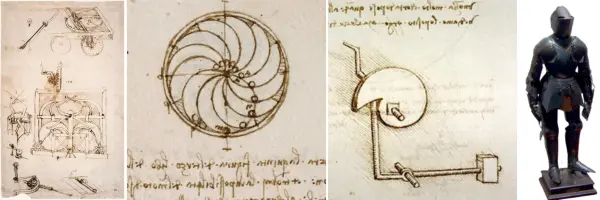
His notebooks, filled with invention sketches, including the mechanical knight, a humanoid robot, and scuba gear for underwater exploration, showcase his forward-thinking approach.
These sketches also illustrate his grasp of engineering challenges and his efforts to overcome them.
Da Vinci’s inventions were not always realized in his lifetime, but they laid the foundation for future technologies.
His analytical methods and artistic skills merged, allowing him to visualize concepts that modern engineers and scientists still admire today.
His work exemplified the Renaissance man’s ability to transcend disciplines, leaving a legacy that merges imagination with technological advancement.
Leonardo da Vinci Mechanical Inventions
Leonardo da Vinci’s mechanical inventions showcase his remarkable range and creativity. His designs went beyond simple novelty, aiming to solve real-world problems.
These creations, from the self-propelled vehicle to the intricate mechanical knight, highlight his innovative approach to mechanics and engineering.
Leonardo da Vinci Car
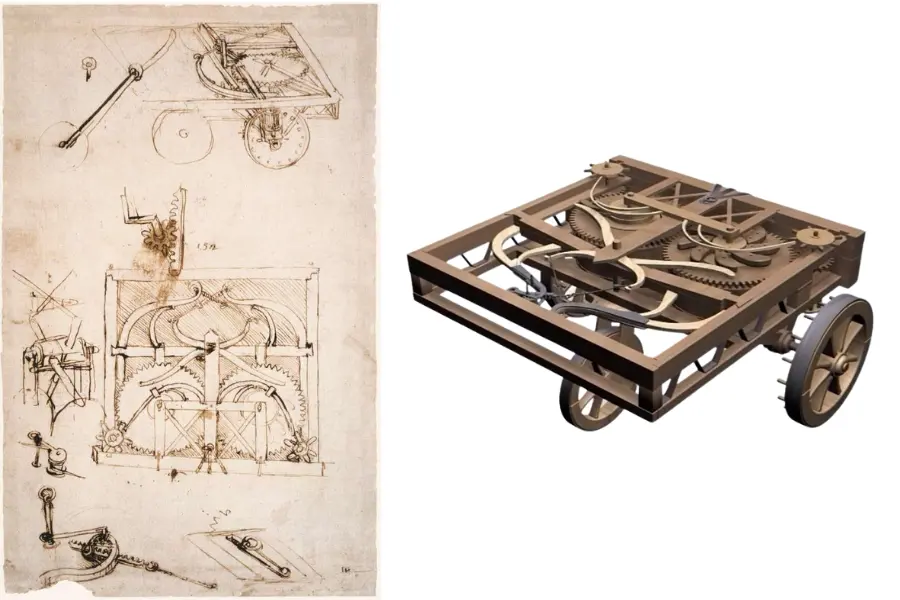
Leonardo created one of the earliest concepts for a self-propelled vehicle. His wooden cart used tightly coiled springs for propulsion, with a steering system to guide it.
This invention is often regarded as one of da Vinci’s significant technological anticipations. Although the technology of his time could not build it, modern reconstructions have demonstrated its potential to function as intended.
Leonardo Mirror Grinding Machine
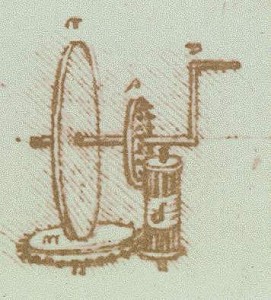
Leonardo mirror grinding machine was designed to create high-quality, curved mirrors.
These mirrors were crucial for observing stars and planets during the Renaissance, advancing the field of astronomy.
The machine used a crank and a series of gears to move a grinding stone over the surface of glass, ensuring precision and consistency. This innovation showcases Leonardo’s expertise in both optics and mechanical processes.
Leonardo’s Perpetual Motion Machine
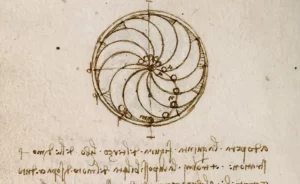
Leonardo explored the idea of perpetual motion by designing various machines that appeared to operate endlessly without an energy source.
His sketches show intricate systems of weights and levers. Despite his efforts, he understood that achieving perpetual motion was impossible due to the principles of energy conservation.
These designs reflect his curiosity and ambition to challenge conventional ideas.
Ball Bearing
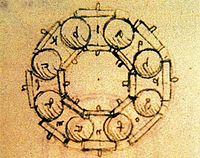
Leonardo da Vinci conceptualized one of the earliest ball-bearing designs.
He incorporated this into various pieces of machinery to reduce friction and improve efficiency.
This small yet powerful invention is crucial in modern machinery, from bicycles to cars. Leonardo’s insight into minimizing mechanical resistance showcases his forward-thinking engineering skills.
Cam Hammer
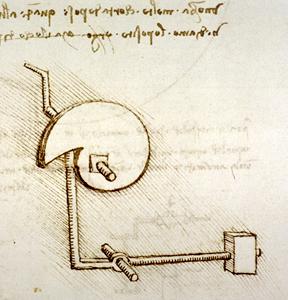
The cam hammer, designed by Leonardo, automated hammering metal, revolutionizing metalworking.
This device used a camshaft to repeatedly lift and drop a hammer, increasing efficiency in forging.
Leonardo foreshadowed the industrial advances centuries later by introducing mechanization to such an essential activity.
Mechanical Knight
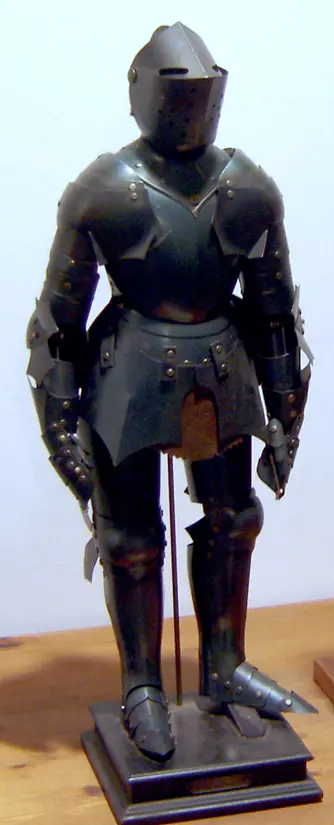
Leonardo da Vinci’s mechanical knight, often regarded as one of his most intriguing creations, demonstrated early robotics.
The knight could sit, wave its arms, and move its head, mimicking human actions.
Powered by a series of pulleys and gears, it illustrated Leonardo’s mastery of anatomy and mechanical systems. This invention is a testament to his interest in robotics and automation.
FAQs about Leonardo da Vinci Mechanical Inventions
Leonardo da Vinci designed a wide variety of machines, including flying machines, the aerial screw (an early helicopter), a parachute, an armored vehicle (a tank), a self-propelled cart, a mechanical knight, and hydraulic devices. Many of these were conceptual designs recorded in his notebooks and demonstrated advanced mechanical thinking for his time.
There is no single agreed “most important” invention, but many historians consider his flying machine concepts to be his most influential. These designs represented one of the earliest scientific studies of flight and helped lay the groundwork for modern aviation.
Leonardo da Vinci was not formally trained as a mechanical engineer, but he worked extensively as an engineer and applied advanced mechanical principles such as gears, pulleys, and leverage in his designs. His work across military, civil, and mechanical engineering makes him one of the earliest multidisciplinary engineers in history.
No, Leonardo da Vinci did not invent the blender. Blenders are modern electrical appliances developed in the 20th century. While Leonardo designed many mechanical devices, none resemble a modern blender or food processor. (No credible historical evidence supports this claim.)
Leonardo da Vinci did not invent robots in the modern sense, but he designed a mechanical knight (automaton) around 1495. This device used gears and pulleys to mimic human movement, making it one of the earliest known concepts of a humanoid machine.
Leonardo da Vinci did not invent a modern machine gun, but he designed multi-barreled weapons, such as the “33-barreled organ,” which allowed rapid successive firing. These designs were early attempts to increase firing speed, but were not automatic weapons like modern machine guns.
 Leonardo Bianchi is the founder of Leonardo da Vinci Inventions & Experiences, a travel and research guide exploring where to experience Leonardo’s art, engineering, and legacy across Italy and Paris.