
(Last updated: April 2026)
The Leonardo da Vinci machine gun is a fascinating example of Renaissance-era ingenuity and foresight. You may find yourself intrigued by the idea of a famous artist contributing to weapons development.
This article will explore how Leonardo da Vinci’s imaginative designs paved the way for future advancements in weaponry.
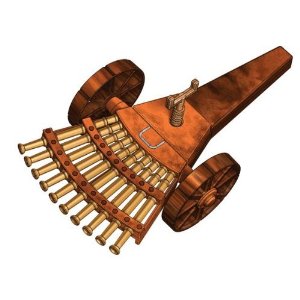
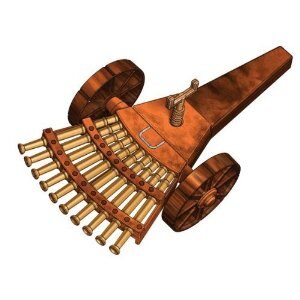
Leonardo’s machine gun, also known as the 33-barreled organ, was a unique prototype designed to address the slow reloading time of traditional firearms. Arranging multiple barrels in a fan shape enabled rapid successive firing, which was groundbreaking for its time.
Though never built, Leonardo’s design was a precursor to modern automatic firearms.
Beyond just the machine gun, this inventive mind conceived various other war machines, including armored cars and giant crossbows. His work as a military engineer demonstrated his unparalleled ability to merge art with practical technology applications.
History and innovation enthusiasts will appreciate how his ideas influence the design of contemporary weapon systems.
Leonardo da Vinci Machine Gun: Historical Context
Leonardo da Vinci’s inventive genius during the Renaissance led to many groundbreaking ideas. His concepts for military technology, such as the machine gun, showcased his imaginative approach to warfare.
Invention during the Renaissance
During the Renaissance, Leonardo da Vinci emerged as one of the most influential figures in art, science, and engineering. His ideas often included significant technological advancements.
The Leonardo da Vinci machine gun is a prime example of his foresight in modern weaponry. Developed in the 15th century, it proposed a rotating barrel system allowing continuous firing without reloading delays. This idea laid the groundwork for future advancements in artillery.
The Renaissance period was marked by a desire to explore new ideas, and da Vinci’s work reflected this spirit of innovation and curiosity. His visionary designs were not limited to weapons but also included concepts like the Leonardo da Vinci flying machine and the much-discussed Leonardo da Vinci tank.
Leonardo da Vinci’s Military Designs
Leonardo da Vinci’s military designs were ahead of their time, encompassing a range of da Vinci war machines. His work demonstrated a deep understanding of engineering principles, which he applied to create innovative solutions for military challenges.
Among his creations, the Leonardo da Vinci machine gun stood out for its unique approach. Featuring a 33-barreled organ gun, it aimed to improve firing rates and efficiency.
While these designs were revolutionary, they remained conceptual during his lifetime. This fascination with engineering extended beyond weapons, influencing later inventors and paving the way for future advancements in military technology.
Design and Mechanisms
Leonardo da Vinci’s machine gun showcases his remarkable ability to envision complex mechanical systems. This innovation foreshadowed the evolution of modern artillery and highlighted his forward-thinking approach to weaponry.
Technical Specifications
The da Vinci machine gun, often compared to the 33-barrel organ, was a marvel of engineering for its time. It featured multiple small-caliber barrels arranged in a fan shape, allowing for simultaneous firing. This design increased the rate of shots and offered a wide spread of bullets.
A crucial feature was its mobility. The gun’s carriage had wheels, enabling easy movement on the battlefield.
Leonardo’s sketches detailed loading mechanisms and the elevation adjustments necessary for aiming. The concept was to overwhelm enemies with a barrage of firepower, a strategy that still resonates in modern artillery systems.
Innovations in Weaponry
Leonardo’s design was ahead of its time in terms of military technology. His war machines, like this machine gun, were part of a broader vision that included other ingenious inventions such as the Leonardo da Vinci tank and the parachute Leonardo da Vinci.
These devices underscore his understanding of the dynamics of war and defense mechanisms.
The concept of rapid-fire artillery, which was not fully realized until centuries later, highlights Leonardo’s pioneering thought. His machine gun laid the groundwork for future developments in weaponry.
Artistic Representation
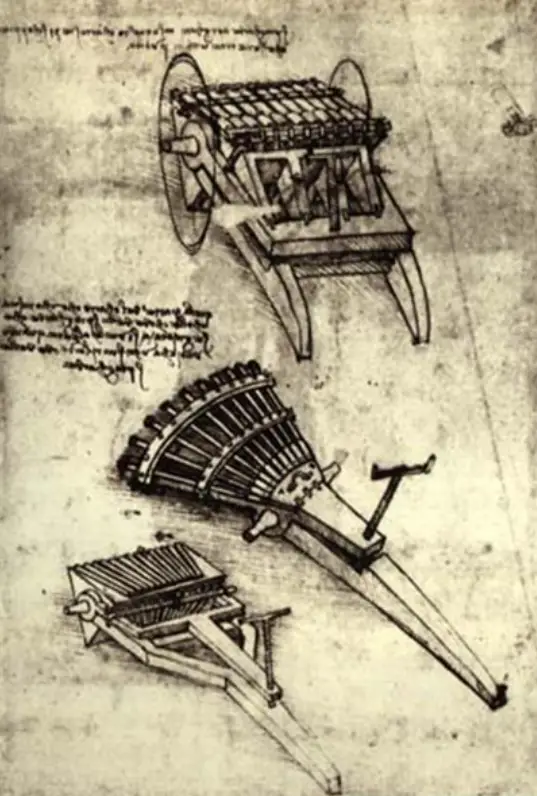
Leonardo da Vinci’s machine gun exemplifies his visionary art, blending mechanics and aesthetics. His sketches reflect his innovative approach to engineering and showcase early ideas that predate modern firearms.
Sketches in the Codex Atlanticus
In the Codex Atlanticus, Leonardo da Vinci created detailed designs for multiple-barrel machine guns. This collection of drawings, part of the Biblioteca Ambrosiana in Milan, includes a 33-barreled organ gun resembling organ pipes aligned together. These sketches highlight his artistic finesse and his ability to envision warfare technology.
Da Vinci focused on machine guns and explored other military inventions, such as the Leonardo da Vinci cannon and various war machines. His designs were intended to improve firing rates in conflict situations.
Though his machine gun concept was never built, it paved the way for modern engineering discussions.
Leonardo’s work exhibits a seamless fusion of art and science. His drawings stand as artistic representations that reveal his unique perspective on innovation. This blend of creativity and engineering showcases da Vinci’s profound impact on art and technology.
Reproduction and Models
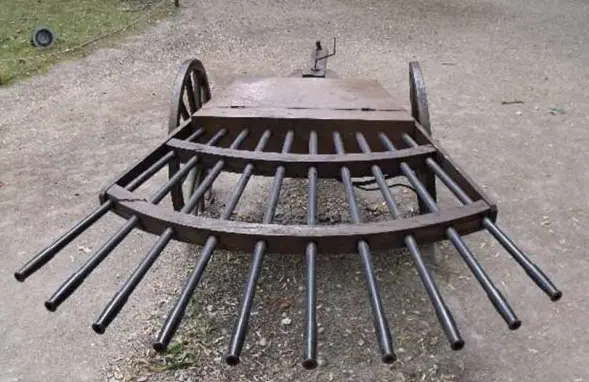
Recreating Leonardo da Vinci’s machine gun involves understanding and adapting his original designs for modern construction. This task appeals to history enthusiasts and engineers who appreciate da Vinci’s ingenuity.
Contemporary Reconstructions
Leonardo da Vinci’s machine gun, sometimes called a rapid-fire crossbow, was detailed in his famous notebook, the Codex Atlanticus. Enthusiasts and historians have recreated this design to explore its practicality. The machine gun aimed to fire multiple shots rapidly, an idea unique to da Vinci’s time.
Producing this machine includes using materials and methods that mirror the 16th-century vision.
The Leonardo3 Museum provides insights into these machines by displaying digital and physical models.
Their exhibits allow visitors to interact with da Vinci’s concepts, including crossbow designs and flying machines. Building these models deepens our appreciation for his inventive genius and showcases how his ideas, such as the Leonardo da Vinci machine gun, remain significant engineering advancements.
Final Thoughts
Leonardo da Vinci’s machine gun designs showcase his remarkable foresight and creativity in the field of weapon innovation. His concept of a multi-barreled weapon addressed the slow reloading times of early firearms.
Several of his designs, like the 33-barreled organ gun, can be seen as prototypes for modern artillery.
Leonardo’s innovative use of multiple cannons firing in succession demonstrated his deep understanding of battlefield needs.
Despite their potential, these designs mainly remained theoretical due to technological and resource constraints. However, his ideas did influence later generations.
Key Takeaways: Leonardo da Vinci’s ideas on machine guns were ahead of his time, laying the groundwork for future advancements in rapid-fire weaponry. His inventive spirit continues to inspire engineers and inventors today.
FAQs about Leonardo da Vinci machine gun
Leonardo da Vinci did not create a true modern machine gun, but he designed a “33-barreled organ”, a multi-barreled weapon that could fire in rapid succession. It used rows of small cannons on a rotating platform to allow continuous firing and cooling, making it a precursor to modern machine guns.
The first true machine gun is generally credited to Hiram Maxim, who invented the Maxim gun in 1884. Unlike earlier designs, it was fully automatic, using recoil energy to reload and fire continuously without manual operation.
Leonardo designed numerous weapons, including the 33-barreled organ gun, armored vehicles (tanks), a giant crossbow, and improved cannons. His focus was on increasing firepower, mobility, and battlefield efficiency through innovative mechanical designs.
Yes, Leonardo da Vinci created many designs for war machines in his notebooks. These included artillery systems, defensive vehicles, and siege weapons, showing his role as a military engineer who applied scientific thinking to warfare.
There is no single “greatest” invention, but some of Leonardo’s most famous designs include the aerial screw (early helicopter), armored vehicle, and multi-barrel gun. These stand out because they introduced ideas far ahead of the technology of his time.
Leonardo da Vinci did not mass-produce inventions, but he created hundreds of innovative designs and concepts across engineering, anatomy, and science. Many were never built, yet they influenced later technological developments and demonstrate his extraordinary creativity.
 Leonardo Bianchi is the founder of Leonardo da Vinci Inventions & Experiences, a travel and research guide exploring where to experience Leonardo’s art, engineering, and legacy across Italy and Paris.