
(Last updated: April 2026)
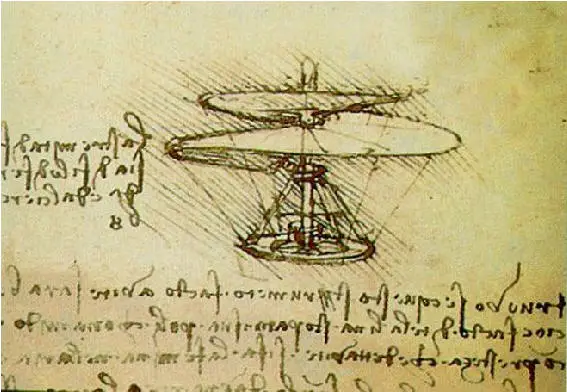
Leonardo da Vinci’s Helicopter, also known as the aerial screw, was a visionary concept long before actual flight was possible.
His design, sketched in the late 15th century, featured a helical screw-shaped rotor that compressed air to lift the device off the ground.
Although it was never built or tested during his lifetime, this idea has fascinated engineers and historians alike, prompting numerous attempts to recreate it using modern materials and technology.
For those intrigued by aviation history, Leonardo da Vinci’s helicopter offers a glimpse into the innovative mind of one of history’s greatest thinkers.
The aerial screw wasn’t just a flight of fancy but a precursor that laid the groundwork for future inventions, including the modern helicopter we see today.
It was more than just a sketch; it showed da Vinci’s deep interest in the principles of aerodynamics and flight.
If you want to explore how ancient ideas have shaped today’s technology, Leonardo da Vinci’s designs still inspire curiosity and innovation.
His work exemplifies how bold ideas can eventually play a significant role in technological advancements.
Explore how this ingenious design inspired concepts in flight, modern drones, and helicopter development, bridging the past with the present in a seamless journey through time.
Background of Leonardo da Vinci

Leonardo da Vinci was a multifaceted genius of the Italian Renaissance whose work encompassed art, engineering, and science. His broad range of skills is best captured in his designs, including the famous Leonardo da Vinci helicopter, which embraced creativity and scientific thought.
Renaissance Man
Leonardo is often described as the ultimate Renaissance Man.
His interests spanned various disciplines, reflecting the era’s ideals of human potential and achievement.
Born in 1452, he became a master painter, sculptor, engineer, and theorist. His knowledge extended beyond art to include anatomy, mathematics, and mechanics.
His detailed studies of the human body and nature are reflected in works like The Vitruvian Man, which illustrates the blend of art and science that characterized his approach.
This diversity of skills laid the groundwork for pioneering ideas, such as the da Vinci helicopter, an early concept of vertical flight.
Contributions to Science and Art
Leonardo’s contributions to science and art were revolutionary.
In art, his enduring masterpieces, such as the Mona Lisa and The Last Supper, showcase his innovative use of perspective and light.
In science, his notebooks reveal a visionary mind engaged in intense study, documenting early concepts of aeronautics, such as the da Vinci aerial screw.
Though these designs were not realized in his lifetime, they highlight a relentless curiosity.
His innovative thinking and meticulous observations continue to influence modern engineering and artistic pursuits, demonstrating how seamlessly he integrated artistic talent with scientific inquiry.
Concept of the Aerial Screw
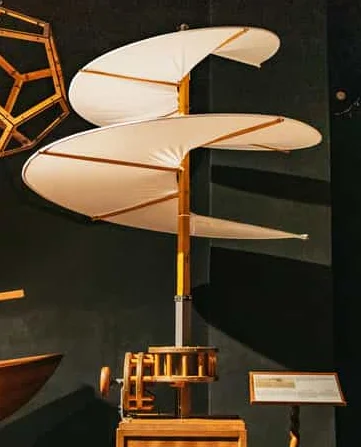
The Leonardo da Vinci helicopter design, often called the aerial screw, is celebrated for its innovative approach to achieving flight. Influenced by nature and da Vinci’s observations, the design showcases both creativity and engineering foresight.
Inspirations and Influences
Leonardo da Vinci’s interest in flight was deeply inspired by his observations of nature, particularly the flight of birds and the dispersal of seeds.
His studies of bird anatomy helped him better understand lift and propulsion. Da Vinci was also influenced by seeds that twist as they fall, like maple seeds.
These natural elements sparked his imagination and guided his vision of flying machines.
In his quest to conquer the skies, da Vinci combined artistry with scientific inquiry. This includes his development of other concepts, such as parachutes.
While a military engineer, the idea of flight captured his attention. He combined practical needs with his fascination with flight.
The Design and Sketches
The aerial screw da Vinci designed featured a spiral shape.
This design consisted of a helical rotor approximately four meters in diameter. The device was crafted from lightweight materials, including reed, linen, and wire.
It relied on human effort. Especially, four men turn cranks on a central platform to generate lift.
Da Vinci’s helicopter sketches provided key insights into his thought process.
His drawings are detailed, showing how he envisioned the mechanism working.
Although Leonardo da Vinci’s helicopter was never built, his drawings laid the foundation for modern aerodynamics and rotorcraft design.
Archimedes’ screw and Leonardo da Vinci’s aerial screw
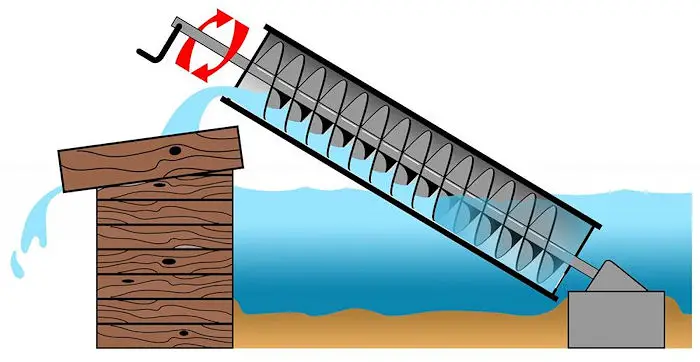
Archimedes’ screw
Archimedes’ screw, invented in ancient Greece, was a pioneering device that utilized a helical surface to efficiently lift water. This screw-shaped pump demonstrated the practical application of rotational motion to achieve vertical movement.
The principles behind this invention provided a foundational understanding of how helical structures could manipulate and move fluids, inspiring future innovations across various fields, including aeronautics.
Leonardo da Vinci’s aerial screw: Inspired by Archimedes
The mechanics of Archimedes’ screw directly influenced Leonardo da Vinci’s design of the Aerial Screw. Leonardo envisioned a helical rotor that could compress air, much as Archimedes’ screw compresses water.
By scaling up the concept and applying it to air instead of water, Leonardo aimed to create a device capable of vertical flight. Although his aerial screw was never constructed, the design demonstrated a sophisticated understanding of helical motion and its potential applications in aviation, laying the groundwork for modern helicopters.
Mechanics of the Helicopter Design
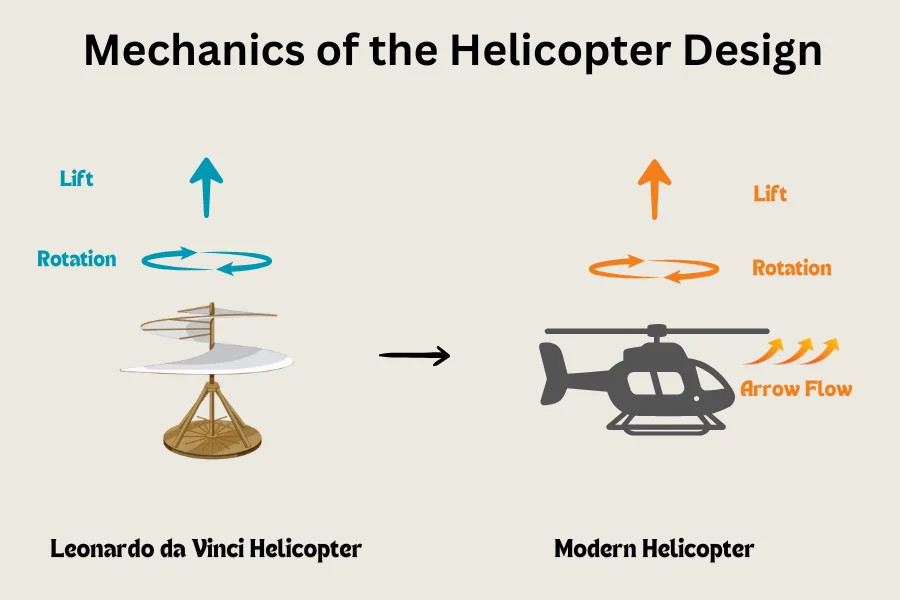
The Leonardo da Vinci helicopter was an early attempt to harness flight using a unique rotating structure.
This section examines the core principles that underpin its flight capabilities, as well as the materials and construction techniques employed.
Flight Principles
Leonardo da Vinci’s helicopter design was based on the concept of the aerial screw.
This apparatus was designed to lift off by spinning its helical surface, much like modern helicopter blades.
The idea was that the screw-like structure would compress the air beneath it, thereby generating lift and allowing the device to rise.
To accomplish this, da Vinci envisioned four men standing on a platform, turning cranks to spin the helical rotor.
This human-powered mechanism suggested an understanding of rotational forces despite the limitations of technology at the time.
Although his design remained theoretical and unimplemented, it provided valuable insights into rotary flight mechanics.
Materials and Construction
Da Vinci’s helicopter was proposed to be constructed from reed, linen, and wire, materials chosen for their lightweight, flexible properties.
The helical rotor, intended to measure around 15 feet in diameter, demonstrated how Leonardo’s keen observation of nature influenced his designs.
The structure of the aerial screw was imaginative, making use of available materials.
Reed offered a solid yet light framework, while linen provided covering, and wire added structural stability.
These choices underscore da Vinci’s innovative approach to design in the absence of modern materials. Though it never flew, his inventive efforts laid the groundwork for future aviation developments.
Impact on Aeronautics
The helicopter, designed by Leonardo da Vinci and often called the aerial screw, has had a lasting impact on modern aviation. This inventive idea inspired future engineers to explore vertical flight and advanced engineering techniques.
Advancements in Vertical Flight
Leonardo da Vinci’s helicopter was a revolutionary concept in the field of vertical flight.
While it was never built due to the technological constraints of the 15th century, the idea inspired later engineers to explore vertical lift, laying the groundwork for future development in helicopter technology.
His sketches depicted a spiral-shaped device designed to compress air and lift the machine.
Although different from modern helicopters, the principles were foundational.
The idea that a flying machine could ascend directly influenced the future of vertical aviation.
The helical air screw design is often seen as a precursor to real helicopters.
Da Vinci’s Legacy in Engineering
The impact of Leonardo da Vinci’s helicopter sketch goes beyond just aviation.
His engineering works showcased his understanding of mechanics, inspiring engineers for centuries.
His keen observations and imaginative designs laid a foundation for many modern engineering principles, encouraging the study of wind dynamics and innovative design.
Da Vinci’s approach to solving complex problems through drawing and modeling continues to influence modern engineering practices.
The Wright Brothers later drew inspiration from his concepts, contributing to the innovation of aircraft controls and aerodynamics.
This legacy endures, as many still draw inspiration from his drawings for designing new technologies.
The Italian Cities Behind the Dream of Flight
Leonardo’s fascination with flight did not emerge in isolation—it developed within Renaissance workshops and courtly environments in Italy. Visiting Florence and Milan offers context for how his aviation studies evolved from sketchbook experiments into ideas that still inspire modern engineers.
How did Leonardo’s Helicopter Work?
Although Leonardo da Vinci’s helicopter was never built, it was a testament to his exceptional innovative prowess. To understand how it might have worked, we need to delve deeper into the mechanics of the design and the principles on which it was based.
From Da Vinci Helicopter to Modern Technology
As we know it today, the helicopter is a marvel of modern technology that took many centuries and many inventors to develop. Let’s explore who created the first fully functional helicopter and how it compares to Leonardo da Vinci’s visionary design.
The First Fully Functional Helicopter
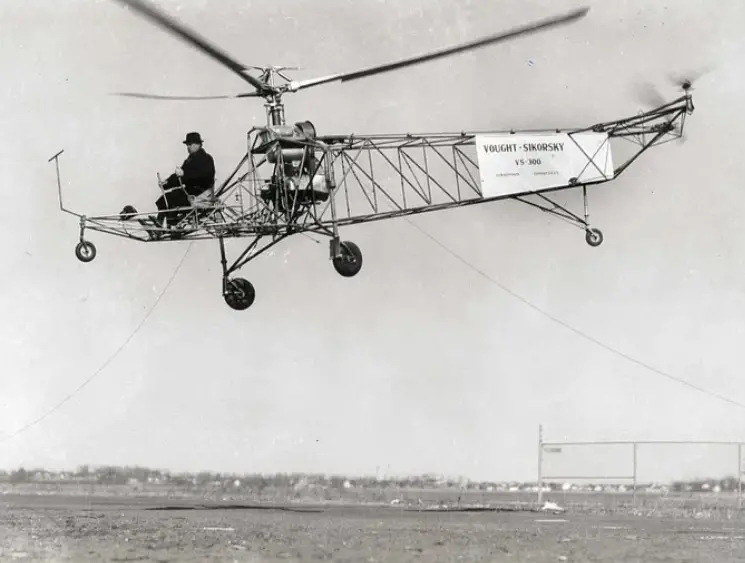
Igor Sikorsky’s VS-300
Russian-American aviation pioneer Igor Sikorsky invented the first practical, fully functional helicopter, the VS-300, which took its inaugural free flight in 1941.
This three-blade, single-engine design marked the start of the modern helicopter age. Unlike Leonardo da Vinci’s helicopter concept, Sikorsky’s helicopter could lift off the ground and be controlled in flight, powered by an engine, a technology unavailable at the time.
Leonardo da Vinci’s Helicopter Design
The Aerial Screw Concept
Leonardo da Vinci’s helicopter, known as the “aerial screw,” was a visionary concept that aimed to generate lift by displacing air downward with a large cork-screw structure made of reed, linen, and wire.
However, it lacked propulsion or control and operated solely on human power. Despite these limitations, da Vinci’s helicopter design was a significant step in the evolution of vertical flight and showcased his incredible ability to think beyond his era.
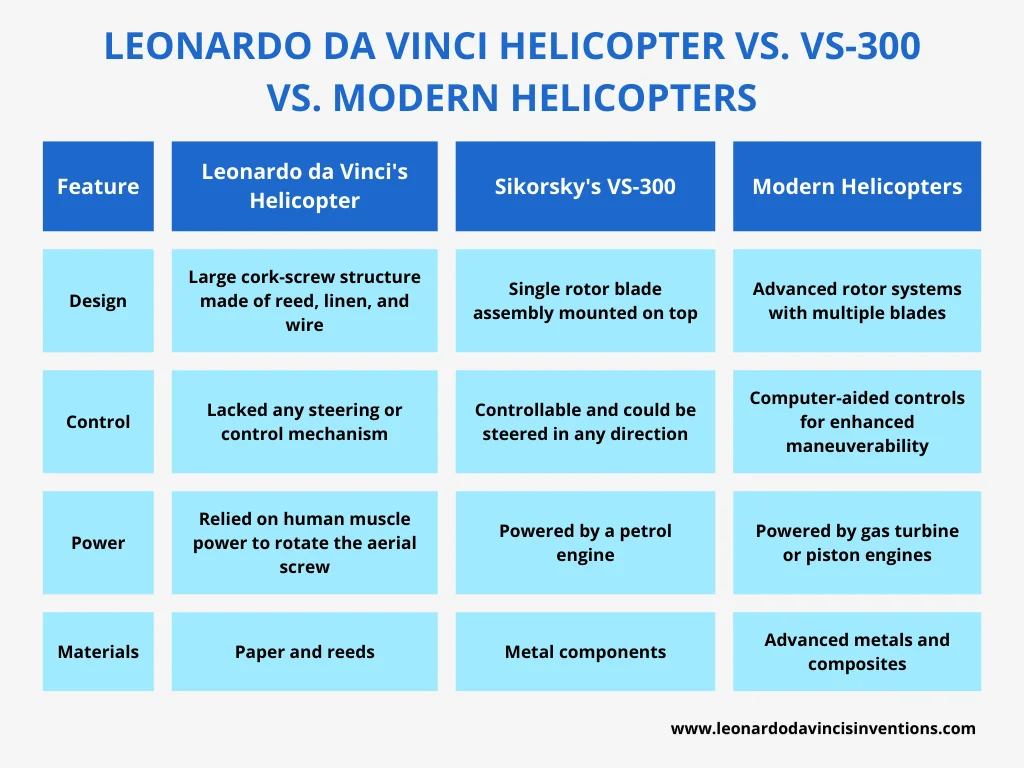
Technological Differences
Leonardo da Vinci’s helicopter relied on human power to attempt flight. His design, the aerial screw, featured a sizable helical rotor intended to be spun manually. This approach contrasts sharply with today’s helicopters, which utilize powerful engines for propulsion, enabling sustained flight and maneuverability.
Modern helicopters use gas turbine or piston engines that provide reliable lift and control, something da Vinci’s design could never achieve because of its reliance on impractical human power. Materials have also evolved, with modern helicopters now using advanced metals and composites that enhance durability and flight performance.
Evolution of Rotary-Wing Aircraft
Leonardo da Vinci’s sketches inspired centuries of aviation development. Although he never built a working model, his ideas echoed through history.
Inventions like the autogiro in the early 20th century brought us closer to what da Vinci envisioned: controlled, sustained vertical flight. Today’s helicopters have undergone significant evolution, featuring complex rotor systems and computer-aided controls that enhance performance and safety.
The evolution from da Vinci’s helicopter design to modern designs highlights progress in aerodynamics and engineering, reflecting mechanical innovation and creative thinking that were first sparked by visionaries like Leonardo da Vinci.
Modern Reconstructions
The Leonardo da Vinci helicopter has long fascinated historians and engineers. Modern reconstructions of this aerial screw attempt to bring his vision to life with today’s materials and technology.
These reconstructions often focus on the foundational elements of Da Vinci’s design, such as the spiral shape intended to lift the machine by hand.
Materials Used
- Wood: Frame structure
- Linen: Canopy for the screw
- Metal: Rotational components
These builds showcase Da Vinci’s innovative design and examine how it might function alongside contemporary engineering.
While Da Vinci’s original vision relied on human power, modern enthusiasts often use motors to simulate the intended lift effect.
Challenges
- Weight: Designing lightweight yet durable materials
- Mechanics: Replicating Da Vinci’s original manual propulsion
- Stability: Ensuring stability during simulated flight
Reconstructing Da Vinci’s designs offers insight into his genius and creativity. Institutions such as the Museum of Science in Boston and the Uffizi Gallery in Florence frequently showcase these models to educate the public about Renaissance engineering.
These exhibits provide context and appreciation for Leonardo da Vinci’s numerous contributions to aviation.
Interest in Leonardo da Vinci’s helicopter invention remains undiminished, continuing to inspire exploration of historical understanding and engineering innovation.
Reconstruction projects serve as a bridge between historical genius and modern ingenuity. By revisiting and reimagining Da Vinci’s work, they remind us of his enduring influence on aviation.
Where Leonardo’s Flight Experiments Still Take Shape
Leonardo’s aerial screw was studied and reconstructed in the same Italian cities where he once filled notebooks with flight observations. In Florence and Milan, museums and exhibits still explore his aviation studies, placing the helicopter sketch within the physical spaces that shaped his thinking.
Explore Leonardo’s World of Flight in Context
Leonardo’s aviation sketches gain new meaning when viewed in the cities where he studied nature, mechanics, and motion. The Leonardo Travel Hub offers a city-by-city guide to the places in Italy where his flight experiments can still be explored today.
Final Thoughts
Leonardo da Vinci’s helicopter design showcased his incredible imagination and foresight. This early concept of vertical flight highlighted his understanding of mechanics, even though it was not feasible with the technology of his time.
His idea included a helical screw meant to lift and propel through the air using manual power.
Despite its limitations, the design remains a fascinating part of history. Scholars often compare Leonardo’s sketches to modern helicopters, noting the structural differences between them.
Modern helicopters use powerful engines, whereas his design relied entirely on human effort, making flight impossible with the materials available at the time.
Da Vinci’s helicopter continues to inspire inventors and engineers. It symbolizes innovation and the pursuit of flight, and many believe it paved the way for future advancements in aeronautics.
His vision encouraged others to explore new ideas in flight and machinery, bridging past ambitions to modern realities.
FAQs about Leonardo da Vinci Helicopter
Leonardo da Vinci did not invent a working helicopter, but he designed the “aerial screw” in the late 1400s—an early concept of vertical flight. His design used a spiral rotor intended to compress air and lift the machine, making it a precursor to modern helicopters.
The first practical and successful helicopter is generally credited to Igor Sikorsky, who developed and flew the VS-300 in 1939. His design introduced the single main rotor and tail rotor system still used in most helicopters today.
Leonardo’s flying machines, including the aerial screw, were never fully built or successfully flown during his lifetime. They remained as detailed sketches and models in his notebooks because the materials and power sources available at the time were insufficient for flight.
Leonardo da Vinci’s most famous invention is often considered to be his flying machine concepts, especially the aerial screw and the ornithopter. These designs represent some of the earliest scientific attempts to understand and achieve human flight.
There is no definitive historical evidence confirming that Leonardo da Vinci had a male lover. He was accused of sodomy in 1476, but the charges were dismissed, and historians consider his personal life largely private and uncertain due to limited records.
Disclosure: This page may contain affiliate links. If you choose an experience through them, it helps support the site at no extra cost to you.
 Leonardo Bianchi is the founder of Leonardo da Vinci Inventions & Experiences, a travel and research guide exploring where to experience Leonardo’s art, engineering, and legacy across Italy and Paris.