
(Last updated: April 2026)
Leonardo da Vinci Crossbow captures the imagination with its blend of art and engineering.
This invention, a marvel of its time, shows Da Vinci’s genius in transforming traditional weaponry into advanced machinery.
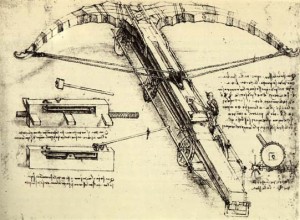
Inspired by ancient ballistae, the giant crossbow was designed to launch large stones or possibly flaming projectiles rather than arrows.
During the late 15th century, Da Vinci’s crossbow represented a significant leap in military technology.
Its innovative crank-and-gear mechanism allowed for powerful launches while maintaining structural integrity.
His meticulous designs, preserved in the Codex Atlanticus, reveal his vision for improving both speed and efficiency in warfare.
Recreating Da Vinci’s crossbow involves understanding the intricate details of his sketches.
Modern engineers have attempted to bring his design to life by crafting models, though adjustments were needed to handle the bowstring’s tension effectively.
This blend of art and science emphasizes the depth of Da Vinci’s insight and highlights the continued relevance of his work beyond his era.
Leonardo da Vinci Crossbow: Historical Context
Leonardo da Vinci‘s ingenious mind led to numerous innovations, including his famous crossbow. Understanding his early life and the state of warfare technology at the time offers insight into his motivation and methods.
Early Life of Leonardo da Vinci
Leonardo da Vinci was born in 1452 in Vinci, Italy. His upbringing in a small town instilled in him a sense of curiosity and innovation.
As a young man, he apprenticed under Andrea del Verrocchio, which refined his skills across art, mechanics, and design. This diverse training laid the groundwork for his future inventions.
Da Vinci’s natural inquisitiveness drove him to explore a wide range of subjects. His interest in anatomy, flight, and warfare made him a Renaissance man. His prolific work, including the Leonardo da Vinci crossbow, is a testament to his inventive prowess.
Warfare Technology in the 15th Century
Warfare experienced significant changes during the 15th century. Traditional weapons, such as swords and simple bows, were gradually replaced by more advanced artillery.
Leonardo da Vinci’s crossbow represented a push towards these new technologies.
Like the giant crossbow, Leonardo’s designs combined existing concepts with innovative mechanisms. He integrated gears and pulleys to increase firing power and accuracy, demonstrating his forward-thinking understanding of mechanical advantage and efficiency.
Leonardo da Vinci’s crossbow was part of a broader interest in his war machines. These included designs for tanks and cannons, showcasing his diverse talents and impact on military technology.
The da Vinci crossbow exemplifies the period’s transition and his significant role in advancing military engineering.
Conceptualization of the Crossbow
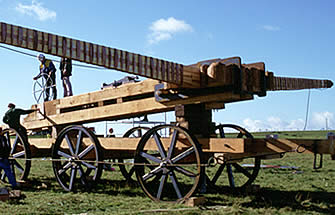
Leonardo da Vinci’s giant crossbow embodies innovation and engineering brilliance. It showcases his ability to blend artistic vision with mechanical precision, serving as a testament to his ingenuity and talent in designing remarkable machines.
Leonardo’s Innovative Design
Leonardo da Vinci envisioned a giant crossbow that would be both a formidable weapon and a psychological tool in warfare.
His design featured a massive frame with a wooden structure reinforced by metal. The crossbow’s size was intended to intimidate and demoralize enemies before launching any projectiles.
Leonardo’s drawings suggest a structure capable of launching large missiles or projectiles, demonstrating his understanding of military tactics.
His approach differed significantly from traditional crossbows. He focused on increasing range and power, effectively allowing the crossbow to strike distant targets.
Leonardo da Vinci’s emphasis on psychological impact highlights his strategic thinking and anticipates modern concepts of warfare intimidation.
Mechanical Principles
The mechanical aspects of Leonardo’s design reveal his deep knowledge of physics and engineering.
The crossbow used a lever-and-pulley system to increase tension, providing greater force when launching projectiles. This mechanism stored and released enormous energy, enabling the hurling of large objects over long distances.
His design also included meticulous details for aligning and stabilizing the massive frame during operation.
This ensured accuracy and efficiency, which were crucial for battlefield use. The fusion of these mechanical elements demonstrates da Vinci’s ability to transform complex concepts into functional devices, solidifying his legacy as a master inventor in numerous fields, including war machinery.
Design Details
Leonardo da Vinci’s crossbow, often called the giant crossbow or ballista, showcases his exceptional skills as an inventor. This design highlights his interest in creating innovative war machines.
Materials and Dimensions
The giant crossbow featured in Leonardo’s plans would have been constructed using a combination of wood, metal, and rope.
The wooden parts provided structure due to their sturdiness and flexibility. Metal components, such as gears and triggers, added precision and strength to the design.
The dimensions of this crossbow were ambitious. It was intended to be enormous, with wheels to help move the hefty machine. The size allowed it to launch large projectiles, making it an effective siege weapon.
Drawing and Sketch Analysis
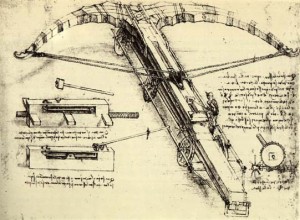
Leonardo da Vinci’s technical drawings, housed in the Codex Atlanticus, provide insight into his engineering prowess.
His sketches detail the crossbow’s external structure and its intricate inner workings.
He used a worm gear mechanism to create a mechanical advantage, allowing two people to draw the mighty bow.
These drawings illustrate Leonardo da Vinci’s ability to blend art with science, showcasing his precision in capturing mechanical details.
His methodical approach to each component, from the wheel placement to the firing mechanism, enabled the realization of such a large crossbow. This design exemplifies his broader interest in military engineering and innovations, much like his work on the da Vinci tank and other war machines.
Comparative Significance
Leonardo da Vinci’s giant crossbow is an intriguing comparison with contemporary and future weaponry. This section examines how it fits into the weaponry of Da Vinci’s time and also reflects on its influence on later innovations.
Comparison between Contemporary vs. Da Vinci Crossbows
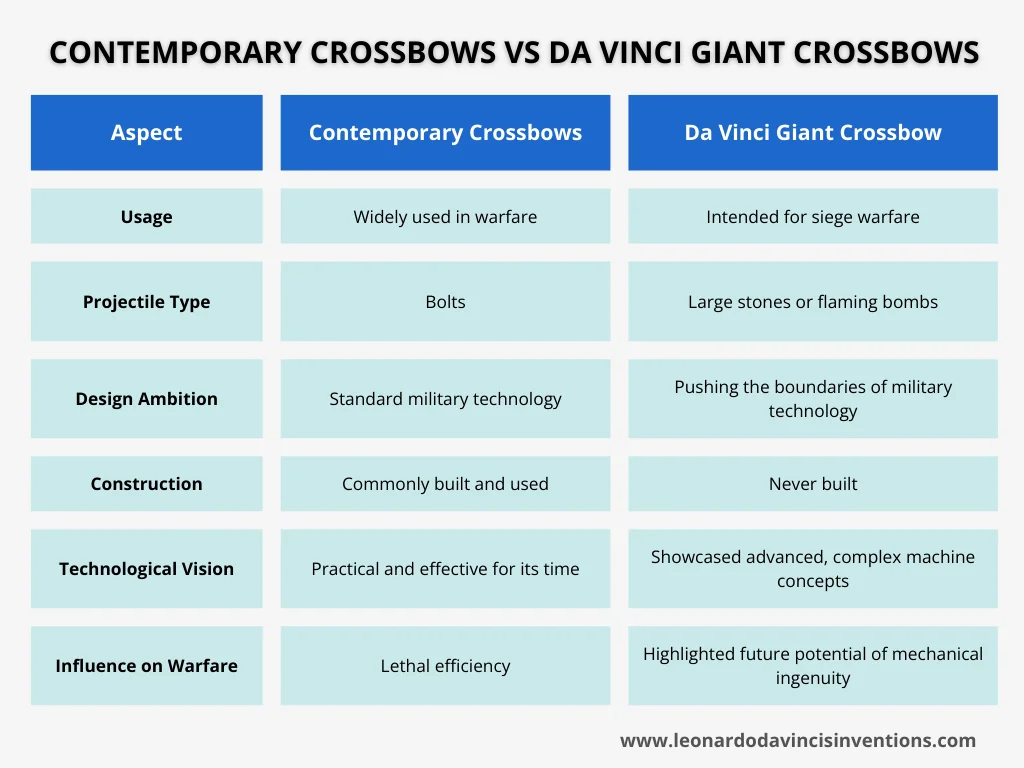
The table highlights the key differences between practical, widely used contemporary crossbows and Leonardo da Vinci’s visionary giant crossbow, showcasing how his design pushed technological boundaries and imagined new possibilities for mechanical warfare.
Influence on Future Inventions
Leonardo da Vinci’s designs, including the giant crossbow, left a significant mark on future innovations.
His technical drawings served as blueprints for inventors to explore mechanical possibilities.
The principles observed in the crossbow mechanisms, such as crank systems and gears, were precursors to future artillery systems.
In particular, the ambition of the giant crossbow foreshadowed more advanced war machines, such as Leonardo da Vinci’s tank.
Involving multiple components to enhance power and accuracy influenced engineers and inventors for generations.
Leonardo da Vinci’s explorations into mechanical warfare underscore his legacy as a visionary thinker who continues to inspire technological advancements today.
Final Thoughts
Leonardo da Vinci’s Crossbow stands as a testament to his inventive genius and mechanical understanding. This giant crossbow, sometimes referred to as a ballista, showcased his ability to merge art and engineering.
The design featured a complex system of gears and cranks that enabled two men to pull back the massive bowstring.
This mechanism allowed for significant power and range. The crossbow could be fired with a release catch, making it efficient in combat.
Key Takeaways:
- The crossbow highlights Leonardo’s blend of innovation and practicality.
- His designs continue to inspire modern engineering and art.
The crossbow remains a symbol of his enduring legacy in both military and artistic fields.
FAQs about Leonardo da Vinci Crossbow
No, Leonardo da Vinci did not invent the crossbow, as it had already existed for centuries before his time. However, he significantly improved and redesigned it, creating advanced concepts such as a giant crossbow and rapid-fire versions, using mathematical precision and engineering principles.
Leonardo’s giant crossbow was designed mainly as a siege weapon and psychological tool. While it could launch large projectiles such as stones or flaming objects, its enormous size was also intended to intimidate enemies and create fear on the battlefield.
Yes, the repeating crossbow was a real historical weapon, but it was not invented by Leonardo. It originated in ancient China as early as the 4th century BC, allowing multiple bolts to be fired quickly using a lever mechanism.
Leonardo da Vinci designed a giant crossbow (balestra gigante), a massive wheeled siege machine. His notebooks describe it as a large-scale weapon intended for warfare, combining mechanical innovation with dramatic visual impact.
The crossbow was not invented by a single known individual. Historical evidence shows it was developed in ancient China and possibly other regions as early as the first millennium BC, evolving over time into more advanced forms.
Leonardo da Vinci did not invent entirely new weapons like guns, but he designed innovative war machines, including the giant crossbow, multi-barrel cannons, and armored vehicles. His work focused on improving existing military technology through engineering creativity.
 Leonardo Bianchi is the founder of Leonardo da Vinci Inventions & Experiences, a travel and research guide exploring where to experience Leonardo’s art, engineering, and legacy across Italy and Paris.