
(Last updated: April 2026)
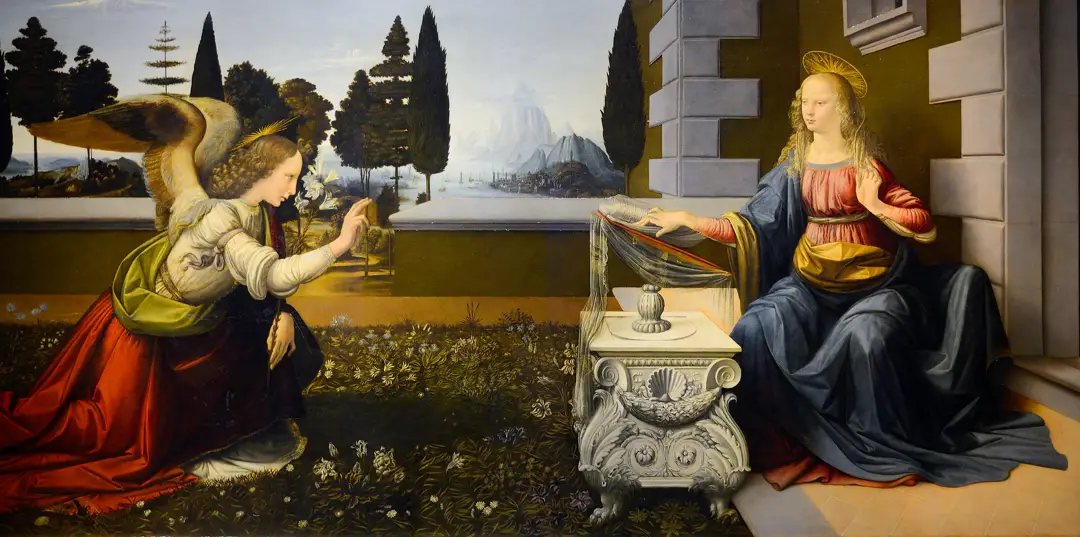
Leonardo da Vinci The Annunciation is a masterpiece that has captivated art enthusiasts and historians alike. If you’re trying to understand its significance and beauty, exploring its elements and historical context can provide clarity and appreciation.
This painting, completed around 1472-1476, marks Leonardo’s earliest major work and showcases the influence of his master, Andrea del Verrocchio.
Set in a serene, natural landscape, the painting captures the biblical moment when the angel Gabriel announces to Mary that she will give birth to Jesus.
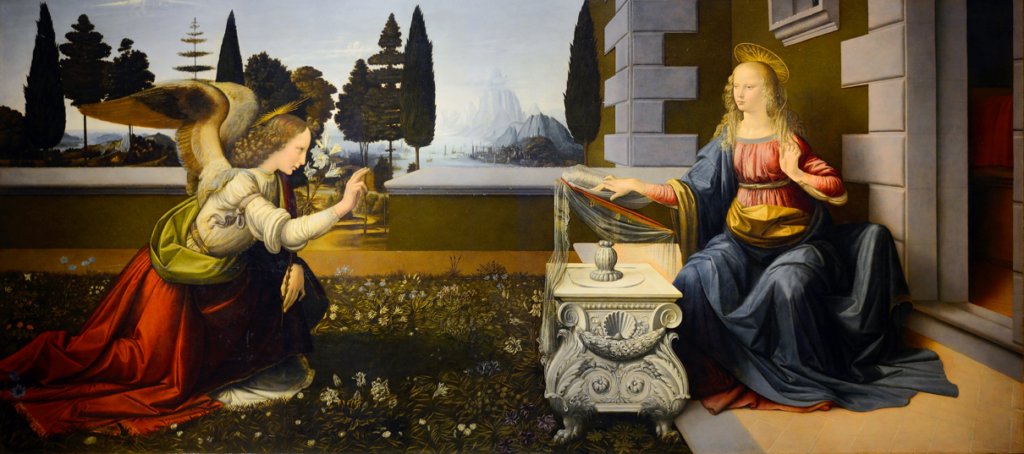
Leonardo’s use of oil and tempera on a poplar panel reflects his innovative spirit and technical prowess. The composition features the angel on the left, the Virgin on the right, and a lectern between them, creating a harmonious scene rich in symbolism and depth.
This early work of da Vinci can be found at the Uffizi Gallery in Florence, where it continues to draw visitors worldwide. The artwork highlights Leonardo’s emerging style and offers a glimpse into the rich artistic traditions of the Italian Renaissance.
By studying this piece, you can gain insight into the young da Vinci’s skill and the cultural heritage of 15th-century Florence.
Historical Context of ‘The Annunciation’
The Annunciation painting by Leonardo da Vinci is of great significance, emerging from the rich cultural and artistic tradition of 15th-century Florence. During this time, Leonardo was still in the early stages of his career, developing distinct techniques that would later define his masterpieces.
Cultural and Artistic Climate of the 15th Century
Florence was a vibrant center of artistic innovation during the 15th century. Wealthy families commissioned works from the most talented artists, and the city saw a surge in patronage.
This period, known as the Renaissance, brought a renewed interest in classical art, science, and humanism. Artists began exploring realistic human forms, perspective, and dramatic lighting.
Leonardo da Vinci and contemporaries such as Botticelli worked in an environment that encouraged experimentation and creativity.
The Annunciation painting exemplifies this, showcasing Leonardo’s early exploration of perspective and human anatomy.
This painting, created using oil and tempera on a large poplar panel, demonstrates a skillful blend of innovation and traditional religious themes. It captures the moment the Angel Gabriel announces to Mary that she will give birth to Jesus.
Leonardo da Vinci’s Early Career
Leonardo began his career as an apprentice in the studio of Andrea del Verrocchio, a leading Florentine artist. This apprenticeship allowed Leonardo to learn various artistic techniques and skills.
The influence of Verrocchio’s workshop is evident in da Vinci’s early works, including The Annunciation.
At the time, Leonardo was tasked with experimenting and perfecting his craft. The Annunciation painting by Leonardo da Vinci marks his emergence as a talented artist, showcasing his ability to blend scientific observation with artistic expression.
His intricate detailing and innovative use of perspective reflect his potential, setting the stage for future masterpieces like the Mona Lisa and The Last Supper.
Analysis of the Painting
Leonardo da Vinci Annunciation showcases the artist’s early expertise in composition, color, and symbolic representation. This painting features complex spatial design, remarkable use of light and shadow, and layered iconography.
Composition and Use of Space
The painting, completed between 1472 and 1476, illustrates da Vinci’s proficiency in linear perspective. He uses a vanishing point to create a sense of depth.
The figures of the angel and Mary are harmoniously placed, creating a balanced composition. Mary is on the right, reading a book, while the angel Gabriel is kneeling on the left.
The background showcases a garden and mountains, adding depth and drawing viewers into the scene. This careful arrangement demonstrates da Vinci’s early commitment to achieving naturalism in his work.
Color and Light Techniques
In The Annunciation, Leonardo da Vinci brilliantly employs a mix of oil and tempera on poplar wood, creating a rich texture.
Natural light pouring over the scene highlights the delicate details of the figures’ clothing and faces. Soft shadows provide depth, creating a three-dimensional effect.
The varied hues establish a serene atmosphere, enhancing the spiritual nature of the event being depicted.
Symbolism and Iconography
The Annunciation painting by da Vinci expertly incorporates symbols common to the Annunciation narrative.
Mary’s posture and the book suggest wisdom and devotion. The angel Gabriel holds a lily, a symbol of Mary’s purity. In the background, the garden refers to innocence and paradise.
These elements, combined with the artist’s focus on realistic human emotions and expressions, make this work significant for the study of Renaissance art.
Technical Aspects and Conservation
Leonardo da Vinci’s The Annunciation showcases masterful use of perspective and materials typical of the Italian Renaissance. Its conservation has involved meticulous efforts to preserve the painting’s intricate details and vibrant colors.
Materials and Methods
Leonardo da Vinci created The Annunciation using oil and tempera on a large poplar panel. This choice of materials allowed him to produce fine details and subtle gradations in tone and color.
The painting features a well-established use of linear perspective, effectively creating depth by having parallel lines converge at a vanishing point.
The sfumato technique, for which Leonardo was known, is evident in the soft transitions between light and shadow. This creates a lifelike and almost three-dimensional effect. Delicate brushwork brings out the figures’ textures and the serene landscape.
History of Restoration
The Annunciation has undergone several restorations to preserve its original brilliance.
Significant attention has been given to cleaning the surface and stabilizing the panel. Old varnishes were removed in past restorations to reveal Leonardo’s vibrant color palette.
X-ray imaging has played a crucial role in analyzing the painting’s layers, helping conservators understand the artist’s process and correct alterations introduced during previous restorations.
These insights have been crucial for preserving delicate features like the angel Gabriel’s wings and the Virgin Mary’s expression.
Such careful restoration ensures that future generations can continue to enjoy The Annunciation painting as a masterpiece of Renaissance art.
Leonardo’s Influence and Legacy
Leonardo da Vinci’s works have deeply impacted both artistic and scientific fields. His painting, The Annunciation, exemplifies his legacy’s blend of creative talent and innovative thought.
Impact on Renaissance Art
Leonardo da Vinci was a driving force in advancing Renaissance art. His use of perspective and human anatomy in The Annunciation revolutionized artistic techniques.
The painting’s detailed portrayal of figures and architecture reflects a mastery of spatial awareness, inspiring artists like Michelangelo and Raphael.
His ability to convey emotion and movement differed from the rigid styles of earlier periods. The fluid grace of figures in The Annunciation influenced countless artists, establishing new standards in art while furthering the humanist movement that defined the Renaissance.
Modern Perceptions and Interpretations
Today, The Annunciation by Leonardo da Vinci continues to captivate audiences and art scholars. Its intricate details and pioneering use of light and shadow invite ongoing analysis and interpretation.
The painting is often celebrated for its artistic value and for embodying the era’s intellectual curiosity.
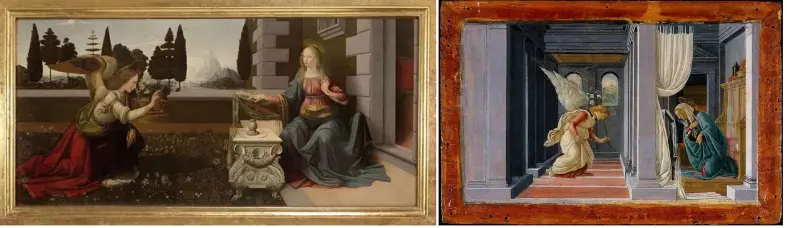
Contemporary art historians often compare Leonardo’s work with his peers, recognizing the pantheon in which he stands among Renaissance greats.
In particular, comparisons with works like Botticelli’s Annunciation help highlight Leonardo’s unique contributions.
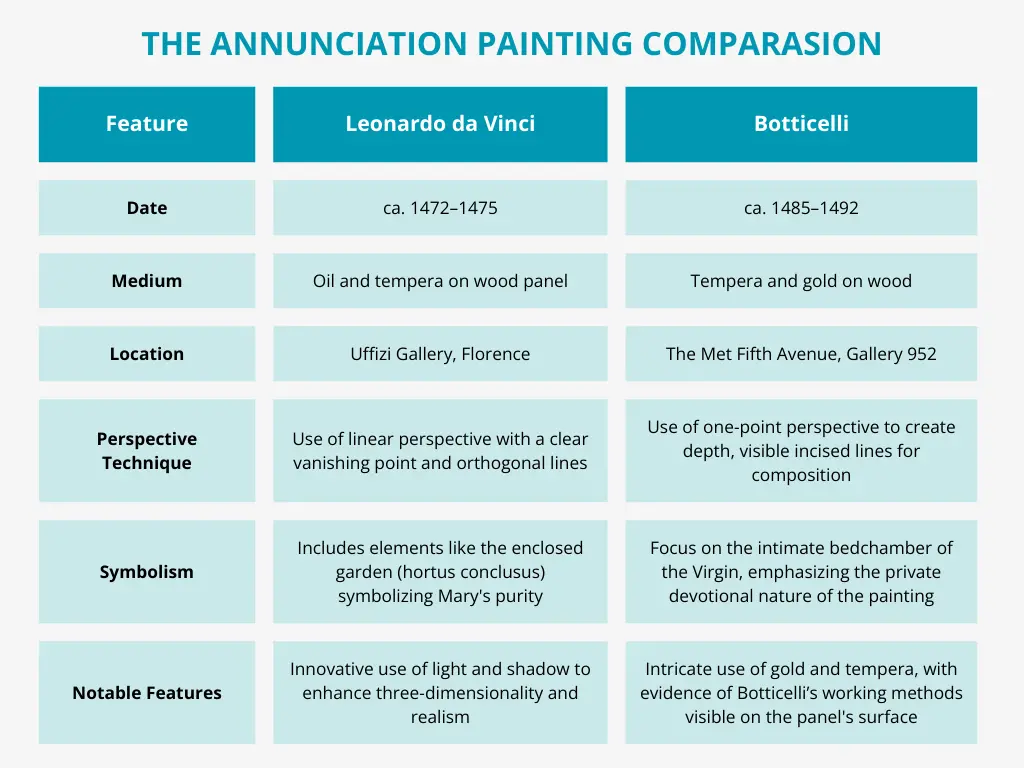
The enduring relevance of his techniques and vision is evident in modern discussions surrounding innovation and creativity in art.
His legacy endures through numerous famous paintings of the Annunciation, thereby securing his status as a pivotal figure in art history.
Location and Public Display
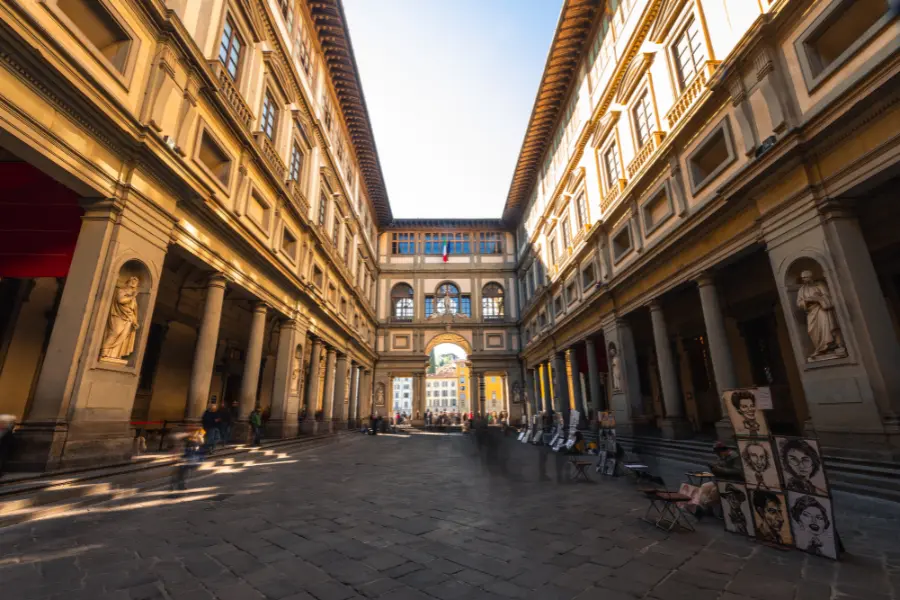
The Annunciation by Leonardo da Vinci is housed at the Uffizi Gallery in Florence, a prominent location that attracts global art enthusiasts. Visitors can explore the public exhibition, which offers insights into this iconic Renaissance work.
The Uffizi Gallery
The Uffizi Gallery in Florence, Italy, is the home of The Annunciation by Leonardo da Vinci. This esteemed gallery is one of the most significant art museums in the world. It offers a chance to view masterpieces from the Renaissance period, including this renowned work.
Arriving at the gallery in 1867, the painting was transferred from the San Bartolomeo Monastery.
Situated in a spacious room dedicated to Leonardo, the gallery offers ample opportunities to appreciate the artwork’s details. The painting signifies da Vinci’s early work, highlighting his initial style influenced by Andrea del Verrocchio.
Exhibition and Accessibility
Visitors to the Uffizi Gallery can see The Annunciation, displayed in a well-organized botanical hall. The gallery’s layout enhances viewing by providing clear sightlines and adequate lighting.
The lighting allows viewers to see the subtleties of da Vinci’s technique.
The gallery’s key feature is accessibility. Guides and information in multiple languages, including brochures and audio tours, allow viewers to engage deeply with the art.
The gallery also ensures accommodations for individuals with mobility challenges, making it inclusive. Regular exhibitions and special events further encourage the public to learn about Leonardo da Vinci’s legendary works of art.
Final Thoughts
Leonardo da Vinci’s The Annunciation is a remarkable example of early Renaissance art. Painted between 1472 and 1476, it showcases Leonardo’s developing style and use of perspective.
The painting is a collaborative effort. While Leonardo completed the final touches, he might have worked alongside other artists. This gives the painting a unique blend of styles, with Leonardo’s touch evident in the intricate details.
Several elements in The Annunciation carry deep symbolic meanings. The angel Gabriel holds a lily, symbolizing purity, while Mary’s book represents divine wisdom.
Such symbols highlight themes of innocence and faith.
The painting also demonstrates Leonardo’s mastery of light and shadow. The gentle transition of shades creates depth, illustrating his grasp of three-dimensional effects. This technique contributes to the painting’s realistic quality.
Key Takeaways: Leonardo da Vinci, The Annunciation blends artistic brilliance and symbolism. Its details and composition reveal the hallmarks of Leonardo’s genius during his formative years.
Understanding the context and craft of this artwork enhances appreciation for its enduring legacy.
FAQs about Leonardo da Vinci The Annunciation
Leonardo da Vinci’s Annunciation depicts the biblical moment when the angel Gabriel tells the Virgin Mary she will miraculously conceive and give birth to Jesus. This scene represents the Incarnation—God becoming human—and the beginning of salvation in Christian belief, often symbolized by elements such as light, gardens, and lilies.
Leonardo painted the Annunciation around 1472–1476, during his early years as an apprentice in Andrea del Verrocchio’s workshop in Florence. It is considered one of his earliest surviving major works, showing both his developing skill and experimentation with perspective and light.
According to the Renaissance writer Giorgio Vasari, Leonardo reportedly said he had “offended God and mankind” because his work did not reach the quality he desired. However, historians note this account may not be fully reliable, as it was recorded after his death and may include legend.
Leonardo was originally buried at the Church of Saint-Florentin in Amboise, France. His grave was disturbed and partly destroyed during the French Revolution, when the church was demolished in 1802, scattering remains and leaving the exact location of his bones uncertain.
According to Christian belief, Mary conceived Jesus through divine intervention by the Holy Spirit, not through a human father. This miraculous conception, announced by the angel Gabriel, is a central element of the Annunciation and the doctrine of the Virgin Birth.
The Annunciation is one of the most important events in Christianity because it marks the moment of the Incarnation—when God became human in the form of Jesus Christ. It has been a central theme in theology and art for centuries and is widely celebrated in Christian tradition.
 Leonardo Bianchi is the founder of Leonardo da Vinci Inventions & Experiences, a travel and research guide exploring where to experience Leonardo’s art, engineering, and legacy across Italy and Paris.