
(Last updated: April 2026)
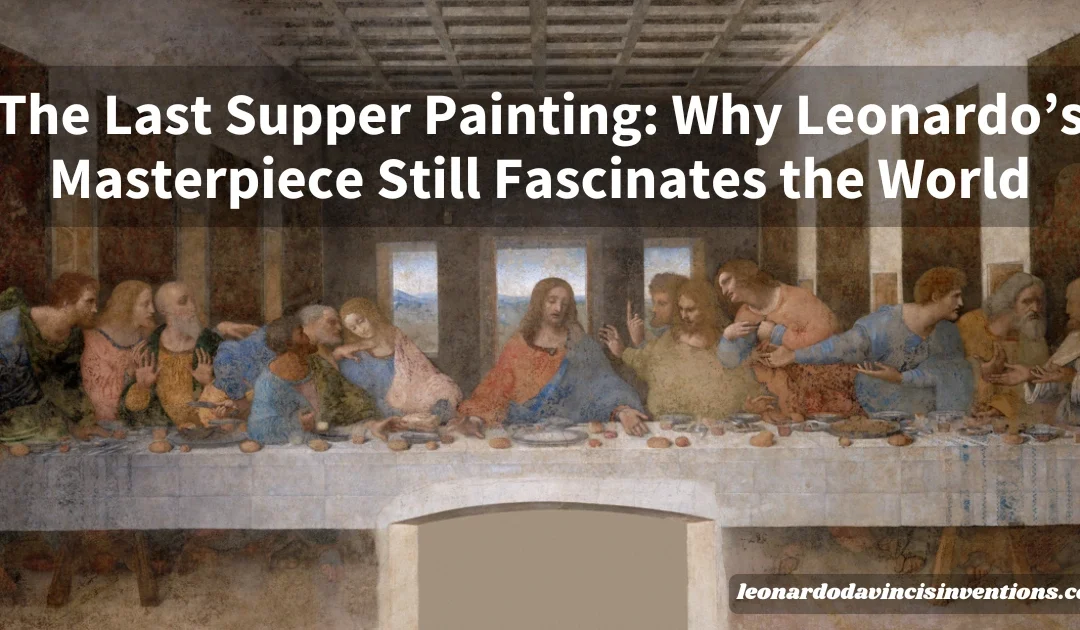
The Last Supper painting is one of the most famous artworks in history. Leonardo da Vinci painted it between 1495 and 1498. This masterpiece captures the moment when Jesus shares his final meal with the 12 apostles, a pivotal scene set before his crucifixion.
The Last Supper represents a crucial biblical moment and showcases Leonardo’s exceptional talent for depicting emotion and narrative through art.
This painting, located in the Convent of Santa Maria delle Grazie in Milan, fascinates art lovers and historians alike. Its dramatic composition and the apostles’ reactions to Jesus’s announcement of betrayal create a powerful visual story.
Those interested in Renaissance art will appreciate Leonardo’s use of perspective and innovative techniques, which have preserved the impact of this work over the centuries.
Whether exploring its religious or artistic aspects, The Last Supper offers a wealth of discoveries. From its creation during the Italian High Renaissance to its ongoing restoration, the painting continues to inspire discussion of its artistic and historical significance.
This post is all about the Last Supper painting that reveals how Leonardo’s genius transforms a simple meal into one of the most studied and revered moments in art history.
The Last Supper painting: Historical Context
Leonardo da Vinci’s “The Last Supper” is a renowned fresco that captures a pivotal biblical event. Commissioned by Ludovico Sforza, it combines artistic mastery and religious significance. It is housed in Santa Maria delle Grazie, one of Milan’s most historic convents.
Creation and Patronage
Leonardo da Vinci’s work on the Last Supper began around 1495 and was completed by 1498. The mural was commissioned by Ludovico Sforza, the Duke of Milan, as part of a larger project to renovate the church of Santa Maria delle Grazie. This involved enhancing its religious and aesthetic appeal.
The painting is located in the convent’s refectory, or dining hall, which was chosen for its size and importance. The large walls suit the composition’s monumental scale.
Leonardo employed innovative techniques to have a profound impact on visual storytelling. The scene depicts Christ’s last meal with his disciples, focusing on the moment when he reveals that one of them will betray him.
Cultural Significance in the Renaissance
The Last Supper is of immense cultural significance, reflecting crucial Renaissance ideals. It exemplifies linear perspective, capturing depth and realism to bring the scene to life with accuracy and emotional impact. This fascination with perspective was a hallmark of Renaissance art, which aimed to render scenes with accuracy and emotional depth.
Leonardo’s work also influences religious art, shaping perceptions of biblical narratives. The portrayal of the 12 disciples, each displaying different emotions, adds a human touch to the divine story.
The Last Supper, created by Leonardo da Vinci, extends beyond its religious context, reflecting broader cultural shifts in art and thought during the Renaissance, with a focus on realism, human emotion, and the use of perspective. This cultural impact remains significant today.
Leonardo da Vinci
Leonardo da Vinci was a master of many disciplines, and The Last Supper painting in Santa Maria delle Grazie in Milan remains one of the clearest expressions of his artistic genius and innovation.
Biographical Overview
Leonardo da Vinci was born in Vinci, Italy, on April 15, 1452. He grew up in Florence and apprenticed with the artist Verrocchio, where he honed his skills in painting and sculpture. Da Vinci was not just an artist but also a thinker, engineer, and inventor, dedicating himself to many fields.
His extensive notebooks reveal his fascination with anatomy, engineering, and the natural world. This curiosity influenced all of his works, including his approach to art and innovation.
Leonardo worked for patrons like Ludovico Sforza, who commissioned the Last Supper. His productive years in Milan allowed him to explore painting, science, and engineering, shaping a legacy across many disciplines.
Artistic Contributions
Leonardo da Vinci’s contribution to art is unparalleled. He pioneered the High Renaissance style, combining scientific observation with artistic expression.
His painting techniques, especially in The Last Supper, showcase his ability to capture human emotion and narrative. This work, which illustrates Jesus’ final meal with his disciples, is celebrated for its composition and use of perspective.
Beyond The Last Supper, da Vinci created iconic works like the Mona Lisa and The Virgin of the Rocks. His art is noted for its intricate detail, innovative use of light, and realistic portrayal of subjects. These techniques continue influencing artists today, cementing da Vinci’s reputation as a cornerstone of art history.
Artistic Analysis of The Last Supper Painting
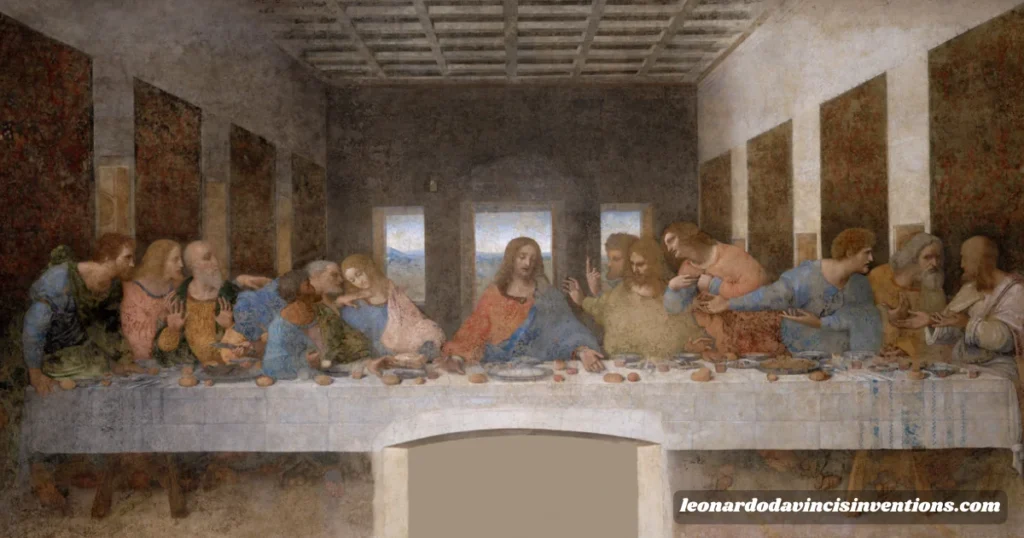
The Last Supper by Leonardo da Vinci is renowned for its masterful use of perspective, color, and symbolism, conveying profound religious themes and showcasing Leonardo’s exceptional talent.
Composition and Perspective
Leonardo da Vinci employed a masterful composition in The Last Supper that highlights its dramatic narrative.
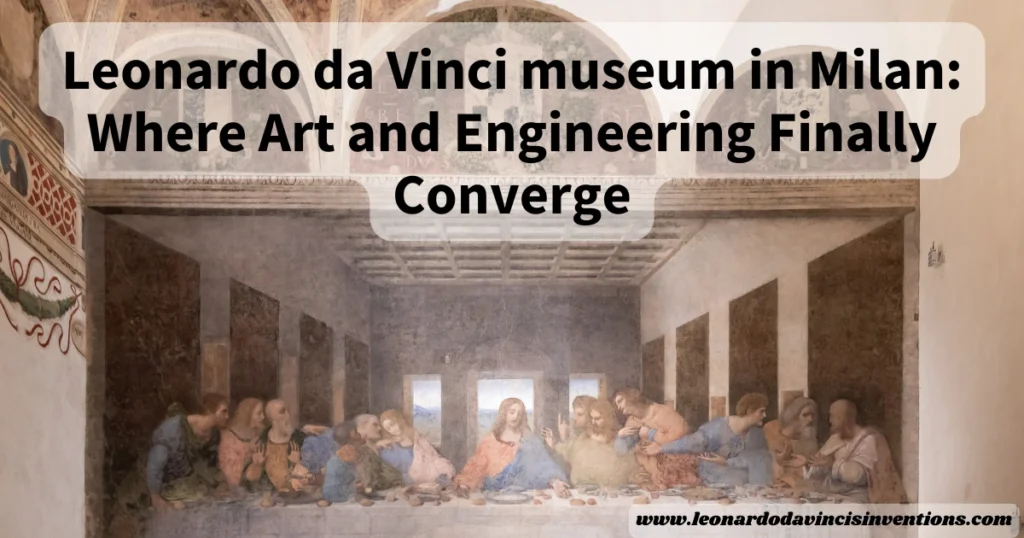
He used a one-point linear perspective, centering on Jesus, to draw the viewer’s attention. The vanishing point is directly behind Jesus’ head, emphasizing his central role in the scene.
The arrangement of the 12 disciples in groups of three creates a rhythmic balance, guiding the viewer’s eye across the painting. The figures’ gestures and expressions convey emotion and tension, establishing a sense of order.
This technique can be further explored by visiting the Last Supper, located at Santa Maria delle Grazie in Milan, where the painting is housed.
Use of Color and Light
Leonardo’s use of color and light adds depth and realism to The Last Supper.
Soft, muted tones dominate the scene, providing a serene yet solemn atmosphere.
The artist ingeniously employed chiaroscuro, a technique that utilizes strong contrasts between light and darkness, to add depth to the figures.
The play of light highlights Jesus’ figure, making him the focal point among the disciples.
Leonardo’s skillful use of color enhances the painting’s realism by reflecting the natural hues of a dining room.
Unfortunately, much of the original vibrancy has been lost due to centuries of extensive damage, though restoration efforts have sought to revive it.
Symbolism and Interpretation
The Last Supper is rich with symbolic meaning, capturing a pivotal moment in Christian tradition.
Each element in the painting, including the positioning of the disciples and the items on the table, carries deeper significance.
Jesus’ open arms symbolize sacrifice, and the scattered elements on the table represent the event’s chaos.
Judas Iscariot, clutching a small bag symbolizing betrayal, adds depth to the narrative.
The disciples’ contrasting reactions, including surprise, doubt, and contemplation, contribute to the scene’s complexity.
This multifaceted interpretation of Leonardo’s work continues to inspire and intrigue viewers today.
What Changes When You See It In Context
Reading about perspective and symbolism is one way to understand The Last Supper, but the work was designed for a specific room and viewing distance. In Milan and other Italian cities shaped by Leonardo, the setting can reveal how architecture, light, and scale influence what the painting communicates.
Religious Significance
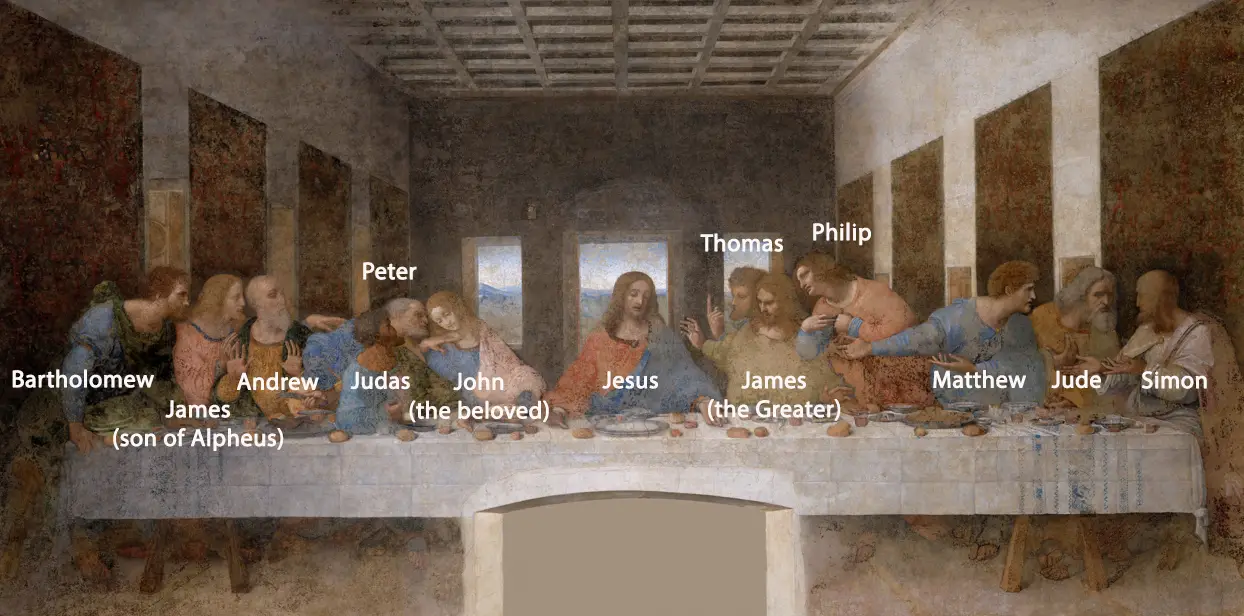
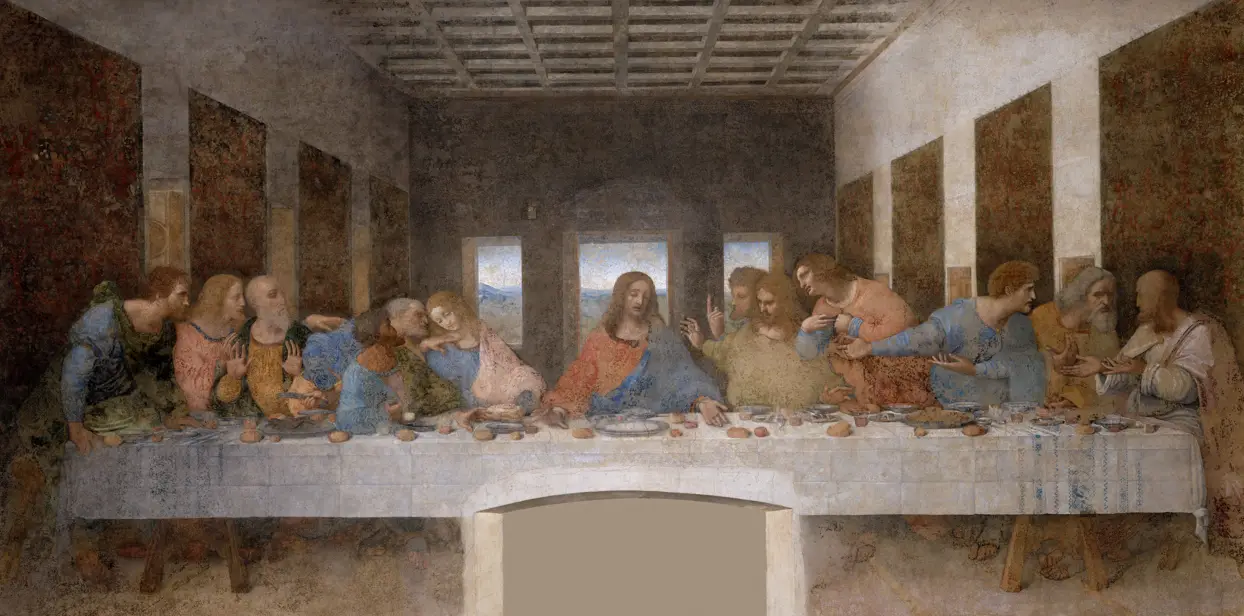
From left to right:
– Bartholomew: referred to as Nathaniel
– James, son of Alphaeus: Spent three years witnessing the teachings of Jesus
– Andrew: The first disciple to be called to follow Jesus
– Peter: His name means ‘rock,’ denied Jesus thrice but repented.
– Judas Iscariot: Betrayed Jesus
– John the Beloved: The youngest disciple and Jesus’ favorite
– Jesus
– Thomas: Doubted Jesus after His resurrection
– James the Greater: The first disciple to be martyred
– Philip: A disciple from the city of Bethsaida
– Matthew: Once a tax collector before becoming a disciple
– Jude Thaddeus: Often shown with a flame around his head
– Simon the Zealot: One of the most obscure apostles
The Last Supper is profoundly significant, as it represents Jesus’ final meal with his 12 disciples, marking pivotal moments such as the establishment of the Eucharist and foreshadowing his betrayal.
Biblical Depiction of The Last Supper
The Last Supper is detailed in the New Testament, specifically in the books of Matthew, Mark, Luke, and John.
Jesus shared bread and wine with his disciples during this event, symbolizing his body and blood. The meal took place in an upper room in Jerusalem just before his arrest.
The setting and acts performed are foundational for Christian practices, especially Communion. The narrative emphasizes themes of fellowship and sacrifice, highlighting Jesus’ teachings and the prediction of Judas’ betrayal.
The depiction underscores the gravity of the events leading to the crucifixion, solidifying the Last Supper’s pivotal role as a turning point in the biblical storyline.
Theological Interpretations
Theologically, the Last Supper is seen as both an end and a beginning.
It finalized the Old Covenant through the Passover lamb and introduced the New Covenant through Christ’s sacrificial role.
It established the Eucharist, in which bread and wine became a recurring sacrament symbolizing Jesus’ enduring presence.
Leonardo da Vinci’s famous artwork, The Last Supper, conveys intense emotions and divine elements, contributing to its theological significance.
This painting is located in Santa Maria delle Grazie, Milan. Artistic representations influence interpretations by accentuating moments of spiritual significance.
The Last Supper transcends its historical significance by reflecting key theological perspectives, making it a central component of Christian faith and practice.
Conservation and Restoration
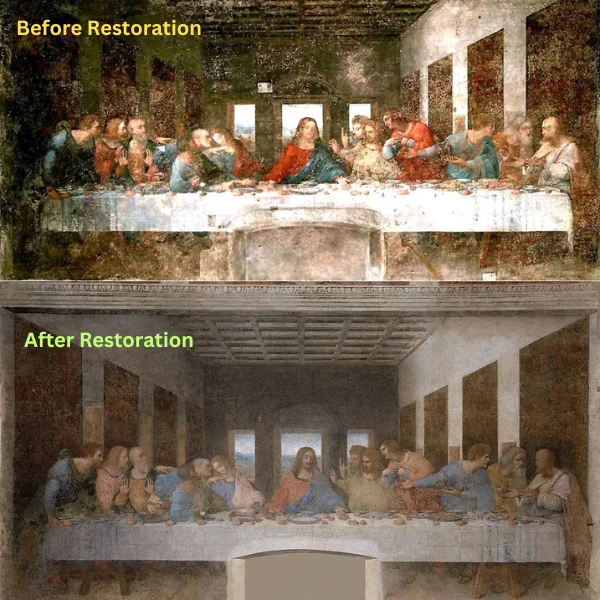
The conservation and restoration of The Last Supper painting have been essential to preserving this masterpiece, which has faced serious deterioration over time.
Degradation Over Time
Leonardo da Vinci’s The Last Supper, located at Santa Maria delle Grazie in Milan, Italy, has experienced severe degradation over the centuries.
Between 1495 and 1498, the painting was vulnerable due to its choice of media and techniques. Da Vinci used oil and tempera on drywall, which was unsuitable for longevity.
Environmental factors further worsened the painting’s condition. Humidity, temperature fluctuations, and pollution led to peeling and flaking.
Additionally, the location was exposed to bombing during World War II, causing structural damage to the building and further destabilizing the mural.
Restoration Efforts
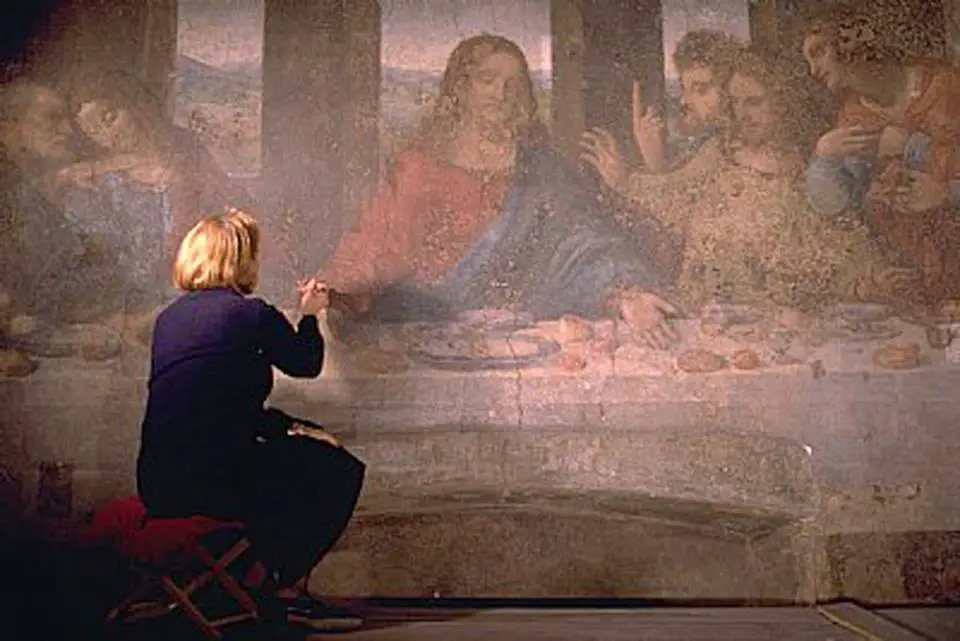
Efforts to restore The Last Supper began shortly after its completion. However, early interventions often did more harm, using aggressive techniques that removed the original material.
From 1978 to 1999, Pinin Brambilla Barcilon led a significant restoration effort that stabilized the paint and revealed hidden details.
During this process, experts carefully removed layers of dirt and previous repairs. They then used scientific analysis to match the colors with da Vinci’s original palette.
This extensive work preserved about 42.5% of the original painting, revealing hidden elements and restoring the scene’s depth and vibrance.
Today, The Last Supper continues to attract visitors, illustrating the challenges and triumphs in art conservation.
Impact and Legacy
The Last Supper by Leonardo da Vinci remains a cornerstone of Western art, with its influence extending to various art movements and its presence felt in numerous facets of popular culture. Its location in the Santa Maria delle Grazie in Milan cements its significance in the realm of religious art and cultural history.
Influence on Later Art
Leonardo da Vinci’s The Last Supper inspired countless artists and art movements. Its revolutionary use of linear perspective created a sense of depth that influenced artists of the High Renaissance and those who followed.
For example, Raphael and Veronese adopted similar spatial strategies in their frescoes.
Leonardo’s portrayal of dramatic expressions also set a standard, emphasizing human emotion in sacred art —a shift from earlier, more stoic representations. Artists aimed to capture the narrative and emotional depth of Leonardo’s work.
The painting’s fame spread across Europe, ultimately impacting art in France and the Netherlands.
Representation in Popular Culture
The Last Supper has transcended the realm of art to become a cultural icon. Its interpretations and parodies appear in films, literature, and advertising. This prominence reflects its lasting impression on both art and society.
Often replicated, the image conveys themes of betrayal and loyalty through its popular depiction of the 12 disciples and Judas’s impending betrayal.
Its role in modern media cements its legacy and makes it accessible to a broader audience.
The painting continues to spark dialogues and portrayals in diverse formats, from digital art to street murals. This enduring legacy underscores the enduring relevance of The Last Supper in contemporary discussions of art and culture.
Controversies and Debates
The Last Supper by Leonardo da Vinci has sparked numerous debates over its authenticity and interpretative meanings. These controversies often center on the accuracy of its depiction of biblical events and the varied interpretations of its rich symbolism.
Authenticity Issues
The authenticity of The Last Supper is questioned. Over the centuries, multiple restoration attempts have been made on the painting, each altering da Vinci’s original work.
Many argue that these efforts have compromised the piece’s authenticity, questioning how much of the original remains.
Experts also debated da Vinci’s techniques, including experimental methods that made the painting susceptible to long-term damage.
Some believe that these methods have partly contributed to the painting’s rapid deterioration. The ongoing conservation efforts aim to preserve what remains while addressing the challenges of maintaining its integrity.
Interpretative Variations
Scholars and art enthusiasts interpret The Last Supper in various ways. Some focus on the unique composition and how da Vinci used linear perspective to direct attention to Jesus.
Others examine the portrayal of the 12 disciples, each of whom exhibits distinct emotions and gestures. These details invite varied interpretations about their relationships and roles during the pivotal moment in the biblical narrative.
Additionally, elements such as food choices and table settings have been analyzed for hidden meanings and theological implications. These details continue to captivate those who study the painting, leading to ongoing debates about the true messages encoded by da Vinci.
Where is The Last Supper Painting Located?
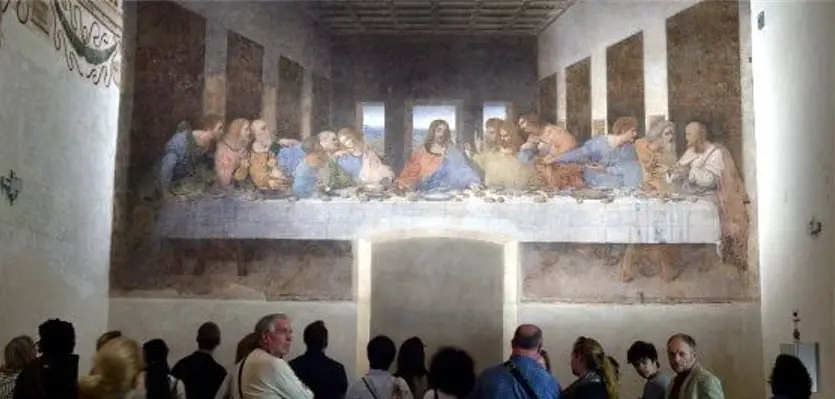
The Last Supper is one of Leonardo da Vinci’s most famous works. It is housed in a historic location in Milan, where visitors can view it in its original setting.
Santa Maria delle Grazie
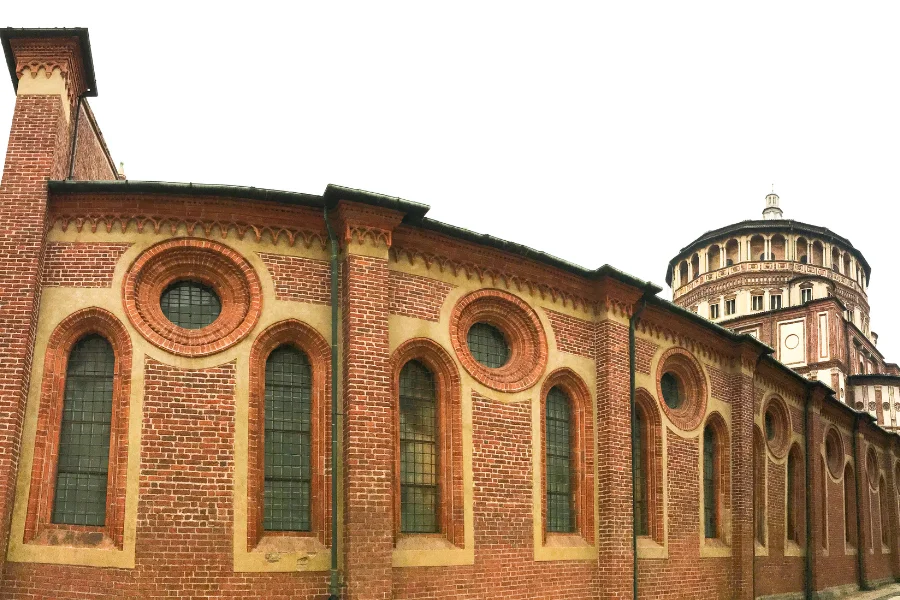
The Last Supper is held at the Dominican convent of Santa Maria delle Grazie in Milan, Italy. This convent is a UNESCO World Heritage site, highlighting its cultural and historical importance.
The painting is displayed on the refectory wall, offering a direct view to those in the dining hall.
Santa Maria delle Grazie was initially commissioned by Ludovico Sforza, the Duke of Milan, to house the famous fresco. The painting depicts Jesus and his 12 disciples during the Last Supper, a pivotal moment in the Bible.
This setting is significant as it maintains the context in which Leonardo intended the painting to be viewed.
Public Exhibition and Viewing
Visitors can experience The Last Supper only through reserved tickets, as the number of visitor spots is limited. This system is essential to preserving da Vinci’s Last Supper painting, which has undergone extensive restoration.
Tours offer insights into the painting’s techniques and the significance of its elements. Usually, groups can view the fresco for about 15 minutes, ensuring the room’s climate remains stable to protect the artwork.
If you plan to visit, it is recommended that you check availability and book in advance to ensure a spot. The official museum site provides more details on viewing The Last Supper.
Following Leonardo Beyond a Single Masterpiece
The Last Supper is deeply tied to Milan, but it’s also part of a wider Italian story that includes Leonardo’s workshops, drawings, and later commissions. Exploring connected places across Italy can help art history enthusiasts see how a single mural fits into a broader network of Renaissance ideas and cultural life.
Explore Leonardo’s Italy Through Place
If The Last Supper sparked your curiosity, the Leonardo Travel Hub offers a city-by-city guide—starting with Milan—to explore key Renaissance locations and their historical significance.
Who Cooked in The Last Supper?
The Last Supper is a pivotal event in both religious traditions and art history. While Leonardo da Vinci’s painting, found in the Santa Maria delle Grazie in Milan, Italy, brilliantly depicts Jesus and his disciples, it does not explicitly show or address who prepared the meal.
Da Vinci’s depiction focuses on the dramatic moment when Jesus announces that one of them will betray him, rather than the meal’s preparation.
In the Bible, the Last Supper, described in the Gospels of Matthew, Mark, Luke, and John, is often referred to as a Passover meal. However, the texts do not specify who cooked the meal.
This tradition involves partaking in unleavened bread and wine, which are symbolically crucial to Christians worldwide.
Rosalind Miles’s book, “Who Cooked the Last Supper: The Women’s History of the World,” examines the often-overlooked roles of women throughout history. While her work does not explicitly address this event, it broadens the discussion about women’s contributions in historical contexts.
Why is The Last Supper Painting Important?
The Last Supper is a groundbreaking mural by Leonardo da Vinci, painted between 1495 and 1498 and housed in Santa Maria delle Grazie in Milan, Italy.
The work is famous for its innovative use of linear perspective, lifelike expressions, and dramatic moments, including Jesus’ announcement of his betrayal to the twelve disciples.
Leonardo’s masterful use of light, composition, and human emotion creates a powerful narrative that has influenced art for centuries. Despite its fragile condition and restoration challenges,
The Last Supper remains one of the most studied and admired paintings in the world, drawing visitors and art historians to Milan to experience this remarkable masterpiece.
Educational Use
The Last Supper by Leonardo da Vinci is a rich subject for academic research and art education. This masterpiece showcases technical brilliance and provides insight into the religious and cultural contexts of its time.
Academic Research and Study
Researchers often study the Last Supper painting to understand Leonardo’s techniques to depict Jesus and his 12 disciples. The original painting is at Santa Maria delle Grazie in Milan, Italy.
Scholars analyze its themes of religious symbolism and perspective. By studying the relationship between the figures, academics gain insights into the scene’s narrative of betrayal and unity.
It is a valuable resource for exploring the intersection of art, religion, and history.
Teaching Renaissance Art
Teaching about da Vinci’s Last Supper helps students understand Renaissance techniques.
The painting is notable for its use of linear perspective, which gives depth to the composition.
Educators can engage students by creating hands-on activities, such as reimagining a scene using different art styles. These exercises teach students about the use of light, shadow, color, and the cultural and historical contexts in which they are applied.
Final Thoughts
This post was all about the Last Supper painting that captures the moment of Jesus’ final meal with his disciples, a pivotal event in Christian theology.
During this gathering, Jesus introduced the bread-and-wine ritual that became the foundation of the Eucharist, while preparing his followers for his crucifixion and Judas’ betrayal, revealing themes of sacrifice, foresight, and forgiveness.
FAQ About The Last Supper Painting
The real Last Supper painting by Leonardo da Vinci is located in the refectory (dining hall) of the Dominican convent of Santa Maria delle Grazie in Milan, Italy. Leonardo painted the mural directly on the wall between about 1495 and 1498, and it remains in its original location today. The church and convent complex are recognized as a UNESCO World Heritage Site because of this masterpiece.
The Last Supper painting depicts the moment in the Bible when Jesus tells his twelve disciples that one of them will betray him. Leonardo captured the dramatic reactions of the apostles as they responded to this shocking announcement, creating a powerful scene filled with emotion and movement. The mural was commissioned by Ludovico Sforza for the dining hall of the Santa Maria delle Grazie monastery in Milan.
Yes, visitors can see The Last Supper painting in person at Santa Maria delle Grazie in Milan. Because the mural is fragile, entry is tightly controlled: visitors usually enter in small groups for a short viewing period to protect the artwork from damage. Tickets often sell out weeks or months in advance.
Leonardo da Vinci was around 43 years old when he painted The Last Supper. He began working on the mural in the mid-1490s during his time in Milan under the patronage of Duke Ludovico Sforza. The project took several years to complete and became one of his most famous works.
No, Mary Magdalene is not depicted in The Last Supper painting. The figures in the mural represent Jesus and his twelve male apostles, as described in the biblical account of the Last Supper. Some modern theories claim that the figure next to Jesus is Mary Magdalene, but art historians agree it is the apostle John, who is traditionally portrayed with softer features in Renaissance art.
Yes, many scholars believe the biblical Last Supper took place at the Cenacle (Upper Room) in Jerusalem, located on Mount Zion. Today, the site is open to visitors and pilgrims who come to see the traditional location associated with Jesus’ final meal with his disciples before his crucifixion.
Related Post You May Like


Disclosure: This page may contain affiliate links. If you choose an experience through them, it helps support the site at no extra cost to you.
 Leonardo Bianchi is the founder of Leonardo da Vinci Inventions & Experiences, a travel and research guide exploring where to experience Leonardo’s art, engineering, and legacy across Italy and Paris.