
(Last updated: April 2026)
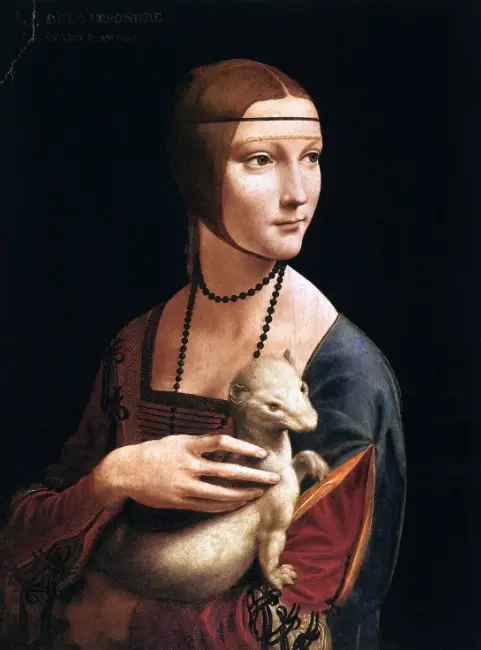
The Lady with an Ermine painting is a portrait generally attributed to Leonardo da Vinci, an Italian Renaissance artist. The Da Vinci Lady with an Ermine, dating from 1489 to 1491, is painted in oil on a walnut panel.
It depicts a half-length woman, rotated three-quarters to the right, with her face turned to the left. The animal in her arms twists similarly, creating significant contrapposto with the lady, a technique Leonardo had previously explored in the angel in the Virgin of the Rocks.
What is the meaning of Lady with an Ermine Painting?
A layer of white gesso and a layer of brownish underpaint are used to prepare the painting. The paint is applied evenly overall, similar to the Mona Lisa, while certain areas of the lady’s skin are more layered.
Its subject is Cecilia Gallerani, an enticing young woman from the Milanese court who was the favorite mistress of Ludovico Sforza, Duke of Milan, at the time of its execution; Leonardo was a painter to the Sforza court in Milan at that time.
For 18 years, the duke was da Vinci’s patron and champion, earning him the moniker “the white ermine.” It is the second of Leonardo’s only four surviving portraits of women, the others being La Belle Ferronnière, Ginevra de’ Benci, and the Mona Lisa.
What is an Ermine?
The Lady with an Ermine painting was purchased by the young Prince Adam Czartoryski (a hero of the war for Polish independence) during his 1800 trip to Italy. Leonardo da Vinci’s Lady with an Ermine was commissioned by his mother, an avid collector and the founder of the Czartoryski Museum.
Art experts first assumed that the animal in the picture was merely a decorative element. They later discovered that ermine is an allusion to Lodovico Sforza. Why is this so? He was also known as Ermellino Bianco (white ermine) at times. Leonardo was unable to paint a couple together due to the upcoming wedding of Ludovico and Beatrice d’Este. That is why he was portrayed allegorically as an ermine, which also covers Cecilia’s pregnancy; Cesare, his son, was born soon after.
The image vanished for generations after Cecilia’s death until resurfacing in Poland around 1800. For many years, it was mistakenly thought to be the likeness of the so-called “Belle Ferronière,” a rumored mistress of King Francis I.
The inscription LA BELE FERONIERE / LEONARD D’AWINCI in the upper left corner alongside the artist’s surname, which is spelled in Polish, attests to this. However, given Poland’s twentieth-century history, it is remarkable that the Lady with an Ermine painting has survived.
What is the price of Lady with an Ermine?
There is substantial debate over whether the Lady with an Ermine picture was created by da Vinci, Boltraffio, or da Predis. During one of his visits, Prince Adam Czartoryski purchased the picture of Lady with an Ermine in Italy.
In 1800, he added the artwork to the Czartoryski Family collection. The picture is now housed at the Czartoryski Museum in Krakow, Poland, but it is currently traveling to museums across the world because the museum is undergoing renovations that began in 2010.
On December 29, 2016, the Princes Czartoryski Foundation, represented by Adam Karol Czartoryski, the last direct offspring of Izabela Czartoryska Flemming and Adam George Czartoryski, who brought the painting to Poland from Italy in 1798, sold it to the Polish government for €100 million.
FAQs about
Leonardo da Vinci’s Lady with an Ermine symbolizes purity, virtue, and nobility, represented by the ermine animal, which was traditionally associated with moral purity. The painting also portrays Cecilia Gallerani, the mistress of Ludovico Sforza, and may subtly reflect her status, pregnancy, and connection to the duke through symbolic imagery.
The Lady with an Ermine is considered priceless and is not for sale, as it is part of Poland’s national cultural heritage. It was included in the Czartoryski Collection, which the Polish government acquired for about €100 million in 2016—far below its estimated market value—making the painting extremely valuable.
Today, Lady with an Ermine is housed in the Czartoryski Museum in Kraków, Poland, where it is regarded as one of the country’s most important national treasures and a highlight for visitors interested in Leonardo da Vinci’s work.
Salvator Mundi is controversial mainly because of ongoing disputes about its authorship and authenticity, with some experts questioning whether Leonardo da Vinci painted it entirely. Its disappearance from major exhibitions and secretive ownership have further fueled debate and speculation.
Elisabeth Lederer was the subject of a portrait by Gustav Klimt. During World War II, many artworks owned by her family were seized, but her portrait survived because it was not confiscated. After the war, it was returned to her family and later passed through private collections before being sold.
Leonardo da Vinci was buried in the Church of Saint-Florentin in Amboise, France, but his grave was disturbed and largely destroyed during the French Revolution when the church was demolished in 1802. As a result, the exact location of his remains is uncertain today.
 Leonardo Bianchi is the founder of Leonardo da Vinci Inventions & Experiences, a travel and research guide exploring where to experience Leonardo’s art, engineering, and legacy across Italy and Paris.