
(Last updated: April 2026)
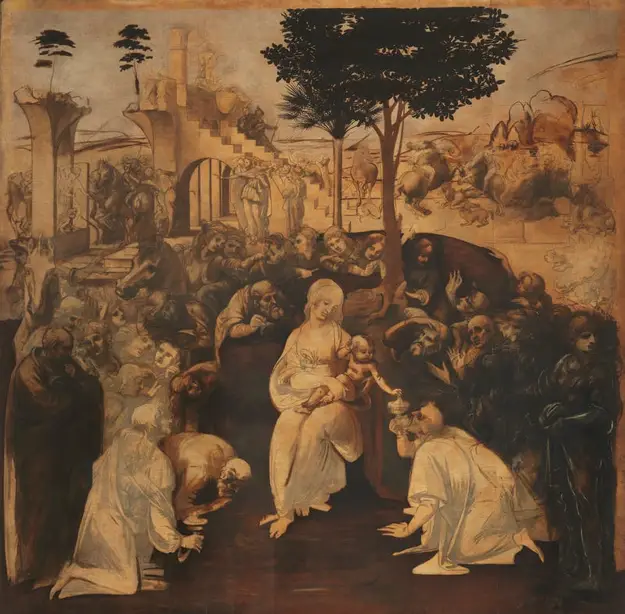
The Virgin Mary and Child are depicted in the foreground of the Adoration of the Magi, forming a triangular configuration with the Magi kneeling in adoration. A semicircle of additional figures surrounds them, including what appears to be a self-portrait of the young Leonardo (on the far right).
The ruin of a pagan edifice is visible in the background on the left, where builders are reportedly working to repair it. On the right, there are soldiers fighting on horseback and a depiction of a rocky environment.
What was the Adoration of the Magi Painting?
A multitude of men and women with uncertain identities surround Mary and the young Jesus, as does the Tree of Life, which is depicted at the back. The painting’s overall theme is the three wise men worshipping the infant Jesus.
As an allusion to the decline of paganism and the arrival of Christianity, the rocky landscape is painted, with a background depicting the ruins of King David’s palace and knights on horseback.
The way people are depicted in the painting marked a milestone in the development of art. The scene features dynamic movement from the individuals and acts surrounding Mary and the child Jesus, who are clearly depicted as the focal point.
Another technique depicted in the artwork is chiaroscuro, in which the contrast between light and dark tones increases as a figure is painted closer to the ground.
Why is the Adoration of the Magi important?
The Adoration of the Magi painting is an incomplete early painting by Leonardo da Vinci, an Italian Renaissance artist. The Augustinian monks of San Donato in Scopeto in Florence commissioned Leonardo in 1481, but he left for Milan the following year, leaving the work unfinished. It has been housed in Florence’s Uffizi Gallery since 1670.
The Adoration of the Magi is one of Leonardo da Vinci’s most unusual and fruitful creations. He turned a mundane biblical subject into a historical scene by merging figures of imploring old men with armed cavalry. Simultaneously, he pushed the non-finito technique to its limit.
On the five boards that make up this panel, the figures and building components are sharply drawn and filled in with earth tones, anticipating the sketchy style that will characterize contemporary painting. This image is notable for its intense concentration and force.
The ruins could be a reference to the Basilica of Maxentius, which the Romans swore would stand until a virgin gave birth, according to Medieval mythology. It is said to have collapsed on the night of Jesus’ birth (in fact, it was not even built until later).
Leonardo’s preparatory perspective drawing, which also features the warring horsemen, is dominated by the ruins. The palm tree in the center is associated with the Virgin Mary, in part because the Song of Solomon phrase “You are stately as a palm tree” is said to foreshadow her.
Restoration of the Adoration of the Magi
The Adoration of the Magi painting was dispatched to a repair team at the Opificio Delle Pietre Dure, an Italian cultural ministry research and conservation center, in 2011. After a six-year renovation, the masterpiece emerged cleaner and brighter in 2017.
The Adoration of the Magi is a fantastic work that continues to uncover numerous secrets as intriguing as those in the “Da Vinci Code.”
FAQs about Adoration of the Magi painting
Leonardo da Vinci’s Salvator Mundi sold for about $450.3 million in 2017 to Saudi Prince Badr bin Abdullah Al Saud, widely reported to have been acting on behalf of Crown Prince Mohammed bin Salman.
Leonardo’s Adoration of the Magi depicts the biblical moment when the three wise men honor the infant Jesus, symbolizing the world’s recognition of Christ. The composition centers on Mary and Jesus, surrounded by figures representing humanity responding to this divine event.
The scene symbolizes the Epiphany—Christ revealed to all people, including different cultures and nations. Elements such as ruins and contrasting background scenes often symbolize the transition from the old pagan world to the new Christian era and spiritual renewal.
The painting is famous because it is an unfinished masterpiece by Leonardo da Vinci, offering rare insight into his creative process, composition techniques, and experimental ideas. Its complex design and visible underdrawing make it one of the most studied works in Renaissance art.
The most expensive painting ever sold is Salvator Mundi by Leonardo da Vinci, which reached approximately $450.3 million at auction in 2017, setting a global record for a work of art.
Leonardo da Vinci was originally buried in the Church of Saint-Florentin in Amboise, France. His grave was disturbed and largely destroyed during the French Revolution, when the church was demolished, leaving the exact location of his remains uncertain.
 Leonardo Bianchi is the founder of Leonardo da Vinci Inventions & Experiences, a travel and research guide exploring where to experience Leonardo’s art, engineering, and legacy across Italy and Paris.